 Angryturtle
Healthcare SEO in Mumbai
How patients search, how Practo sits alongside Google, and how to structure multi-doctor and multi-branch profiles, for hospitals, clinics and diagnostic centres in Mumbai.
·
Mumbai addresses run on building names, not street numbers, and that single fact breaks more hospital and clinic Google Business Profiles than any category mistake does. A cardiologist whose clinic sits on the fourth floor of "Merchant Chambers" near Bandra station types that building name into the address field the way a patient would recognise it, and the map pin lands two streets off because Google's geocoder can't parse "4th Floor, Merchant Chambers, opp. Bandra Talao" the way it parses a numbered street address in a city built on a grid. That's the starting problem for healthcare SEO in Mumbai, and it's specific to how this city is built, not something a Delhi or Bangalore playbook would ever catch. This page covers what actually moves a Mumbai hospital, clinic, diagnostic centre, or individual practitioner up the local pack, whether the search that brought a reader here was healthcare SEO in Mumbai, a healthcare SEO agency in Mumbai, healthcare SEO services in Mumbai, or a healthcare SEO company in Mumbai — the diagnosis and the fix are the same regardless of which phrase led here.
Mumbai's suburban rail line also does something no other Indian city's geography does to healthcare search: it segments demand by which line a patient rides, not just by which neighbourhood they live in. A patient searching for a paediatrician doesn't think in terms of a five-kilometre radius the way Google's ranking system does — they think "something on my way home on the Western Line" or "walking distance from Andheri station." A clinic that ignores this is optimising for a radius that doesn't match how its own patients actually travel.
Contents
- The building-name addressing problem, and how to actually fix it
- Mumbai's rail geography and how patients search by it
- Bandra, Andheri, Powai, Parel: four very different competitive sets
- Practo alongside Google in Mumbai
- Category accuracy and secondary categories
- Multi-doctor and multi-branch profile structure
- Reviews within medical-advertising limits
- Worked example: a diagnostic centre chain across three Mumbai suburbs
- What Angryturtle does here
- Where this isn't the right fit
- FAQ
The building-name addressing problem, and how to actually fix it
Google's geocoding works best against a clean street-number-and-street-name pattern. Mumbai addressing rarely gives it that. A clinic's real address might be "302, Trade Centre, Bandra Kurla Complex" or "Ground Floor, Kalpataru Habitat, near Parel ST Depot" — building name first, landmark second, street number nowhere at all in the way a patient actually uses it. When that gets typed into the GBP address field verbatim, the pin sometimes lands correctly and sometimes drifts to the centroid of the pincode, which is close enough to look right on a desktop map and far enough to send a walk-in patient to the wrong gate.
The fix isn't clever. Pin the exact location manually by dragging the map marker in Google Business Profile rather than trusting the geocoder's guess from the typed address, verify it against Google Maps directly (not the GBP dashboard preview, which can lag), and keep the landmark in the address line even though it looks redundant — "near Bandra Talao" does real work for both patients and Google's confidence in the location, even after the pin itself is corrected. A wrong pin doesn't just cost the odd frustrated patient. It quietly suppresses the whole profile in "near me" results, because local ranking factors weight proximity against the pin's actual coordinates, not the address text.
Mumbai's rail geography and how patients search by it
A patient on the Western Line searching for a dermatologist rarely means "anywhere in Mumbai." They mean somewhere between two or three stations they'd actually get off at — Bandra to Andheri, say, or Borivali to Malad. A patient on the Central Line thinks the same way about Dadar to Kurla. This matters for a clinic deciding where to open a second branch and for how a single-location practice should think about its realistic catchment: a Bandra clinic is not really competing with a Powai clinic for the same search, even though both carry the "Mumbai" city label, because almost nobody crosses that far for a routine appointment when three closer options exist.
Search phrasing reflects this too. "Gynaecologist near Andheri station" and "gynaecologist Andheri west" pull slightly different result sets, and a profile that only has "Andheri" in its address and description, without the station or the east/west distinction that locals actually use to navigate, is invisible to a chunk of that demand.
Bandra, Andheri, Powai, Parel: four very different competitive sets
Bandra runs dense with long-established single- and two-doctor practices, many decades old, competing mostly on reputation and proximity within a genuinely small radius — the kind of market where a GBP listing claimed in 2018 and never touched since is still holding position purely on review volume, and a newer clinic has to out-execute rather than out-wait it. Andheri, particularly around the station and the western suburbs corridor, has a much higher density of diagnostic centres and multi-speciality clinics, riding the same commuter traffic that makes the area a retail and office hub, which means the competitive set here is wider and category precision matters more because there's more noise to cut through.
Powai is different again — a newer, more planned neighbourhood with corporate housing and IT-park proximity, where patients skew younger, search more on mobile, and check reviews before booking rather than relying on a neighbour's recommendation the way an older Bandra patient might. Parel and the hospital corridor around it (Lower Parel, Elphinstone) is dominated by large multi-speciality hospitals that compete on bed count, emergency capacity, and specialist depth more than on local SEO fundamentals — their scale carries them past mistakes a standalone clinic can't afford. A diagnostic centre opening its second branch in Powai after building a Bandra reputation is not competing against the same field it built its name in, and treating both branches with an identical keyword and review strategy usually underserves whichever one is newer.
Practo alongside Google in Mumbai
Practo carries real weight in Mumbai for specialist appointment bookings — a patient comparing dermatologists, gynaecologists, or orthopaedists by consultation fee and available slot often starts there rather than on Google Maps, the same pattern covered in more general terms in Google Business Profile versus Practo for healthcare. What's specific to Mumbai is how much of that comparison shopping happens on a commute — a patient scrolling Practo on the train between stations, narrowing by locality and fee before ever opening Google. A stale Practo listing, one still showing a doctor who left the practice or a consultation fee that changed eight months ago, loses that comparison silently, with no complaint or bad review to flag it, just a booking that went to whichever listing looked current.
Google Business Profile and Practo need to be treated as one consistent presence rather than a primary channel and an afterthought. A profile that's immaculate on Google and neglected on Practo is still losing appointments it should be winning.
Category accuracy and secondary categories
A general physician listed under the plain "Doctor" category is competing against every kind of medical practice in a one-kilometre radius for searches it should be winning outright on relevance alone. The fix is the same one covered in full in choosing the right GBP category — pick the closest specific primary category and layer genuinely applicable secondary categories on top, without padding the list with categories the practice can't actually document. Healthcare listings get reviewed more strictly than most verticals for exactly this reason; a category that doesn't match what's verifiable against registration and premises detail risks a suspension flag rather than just a relevance loss, covered at length in GBP suspension reasons.
Multi-doctor and multi-branch profile structure
A two-doctor practice sharing one address needs exactly one GBP listing, with both doctors named in the business description and services list rather than each claiming a separate profile at the same address — a mistake that reads to Google as a duplicate listing and gets flagged accordingly. Where it gets genuinely more complicated is a diagnostic chain or multi-speciality clinic running three or four Mumbai branches: Bandra, Andheri, and Powai, say, each needing its own listing with its own accurate address, hours, and review base, held together by consistent branding and a shared NAP standard across every directory that carries the business, the mechanics of which are covered in NAP consistency at scale. A flagship Bandra branch with eight years of reviews and a six-month-old Powai branch with a dozen are not comparable, and running an identical review-generation cadence across both usually leaves the newer branch permanently behind. Hospital-scale multi-department structure, where a single large facility has to represent cardiology, maternity, and an emergency department under one listing, is covered in more depth in the piece on hospital SEO in India, worth reading for any Mumbai hospital past the single-department stage.
Reviews within medical-advertising limits
Review volume and rating matter here the way they do everywhere in local search, detailed in reviews and AI search visibility, but healthcare carries a compliance constraint most other Mumbai verticals don't. A review reply must never confirm that the reviewer was actually a patient, must never discuss a specific condition or treatment even to correct a factual error in a negative review, and must never make a comparative claim about clinical quality against a named competitor. The safe pattern is to acknowledge the review, restate the general standard the practice holds itself to, and move any specifics to a named offline contact rather than arguing details in public. This isn't a workaround-able rule, and any agency offering to write outcome-based content or draft review replies that confirm patient identity is creating regulatory exposure for the practice, not delivering an edge. Listing work of this kind affects how discoverable a practice is — it has no bearing on and makes no claim about clinical results, and content shouldn't imply otherwise even indirectly.
Worked example: a diagnostic centre chain across three Mumbai suburbs
The scenario below is illustrative rather than a client account, and the numbers in it are there to show the shape of the problem. A diagnostic centre chain running branches in Bandra, Andheri, and Powai built its Bandra reputation over six years and expanded to the other two suburbs eighteen months ago. All three profiles use an identical description and an identical review-request script, copied from the flagship location. Bandra sits at 340 reviews. Andheri sits at 60. Powai sits at 22, most from staff and family rather than genuine patients — a pattern that shows up as an unusually front-loaded review timestamp cluster and is itself a soft flag Google's system can catch.
Treating all three as one brand with one strategy is the actual mistake. The fix starts with correcting each branch's address pin independently, since Andheri and Powai addresses were copy-pasted from a template with the wrong building landmark. Then each branch gets its own review-generation target scaled to its age rather than a shared chain-wide number, with the front-desk script varied by branch language mix — Bandra skews more English and Hindi, Powai's younger corporate patient base responds better to a WhatsApp review link than an in-person ask. Category and schema stay consistent across all three, because that part genuinely should be identical. What shouldn't be identical is the review timeline expectation for a six-year branch versus an eighteen-month one.
What Angryturtle does here
None of the fixes above require a platform to execute by hand — pinning a location correctly, fixing a category, and adjusting a review-ask script are all things a practice manager can do in an afternoon per branch. Where a platform earns its keep across three or more Mumbai locations is in tracking which branch is actually falling behind and why. Angryturtle's Rank OS scores relevance, review health, freshness, entity authority, and AIO readiness per listing rather than assuming a chain is fine because its flagship is, and geo-grid tracking shows rank separately across Bandra, Andheri, and Powai instead of one averaged Mumbai number that hides exactly the gap this worked example describes.
For practices that want the fixes made rather than a dashboard to make them from, managed GBP services cover category audits, review workflows built around the compliance limits above, and citation cleanup across the directories that carry weight in Mumbai. If a listing has already been suspended, the GBP reinstatement service and the companion guide on writing a GBP reinstatement appeal cover what the appeal needs. See the healthcare industry page for how the platform's cluster taxonomy adapts specifically for medical practices, the general Mumbai GBP management guide for the citywide fundamentals this page builds on, and local SEO agency selection in Mumbai for what to check before hiring anyone. The programmatic hub at /local-seo/mumbai/healthcare tracks Mumbai-specific healthcare search demand, alongside the citywide view at /local-seo/mumbai. For a broader directory checklist, the listicles on local SEO tips for doctors in India and GBP tips for hospitals in India cover adjacent ground. Pricing for a managed engagement or self-serve plan is on the pricing page.
Where this isn't the right fit
A single practitioner with a full appointment book and no ambition to add a second branch may genuinely not need any of this — an accurate pin and a correct category are worth doing regardless, but an ongoing managed engagement is overhead a busy solo practice doesn't need. None of the above substitutes for good clinical care either; a corrected map pin brings the right patients to the door, it doesn't keep them, and no amount of review-script optimisation fixes a practice that isn't actually good. This is general guidance, not medical or legal advice, and nothing here guarantees a specific ranking outcome — Google's local algorithm and its healthcare review process are both outside any tool's or agency's control. Book a demo or get in touch to talk through a specific Mumbai listing.
FAQ
Why does my clinic's Google map pin land in the wrong place even though the address looks correct? Mumbai's building-name addressing convention often confuses Google's automatic geocoder, which is tuned for street-number patterns. The fix is to manually drag and confirm the pin location in Google Business Profile rather than trusting what the address text alone generates.
Should a Mumbai clinic prioritise Google Business Profile or Practo? Both, because they serve different parts of the same booking decision. Google Maps still drives most "near me" and walk-in-adjacent search, while Practo carries real weight for specialist appointment comparison shopping, often done on a commute. Treat them as one consistent presence.
Does a two-doctor clinic need two separate Google Business Profiles? No, generally one listing at the shared address is correct, with both doctors named in the description and services list. A second profile at the same address usually gets flagged as a duplicate rather than helping either doctor's visibility.
Can a review reply confirm someone was a patient or discuss their treatment? No. The safe pattern is acknowledging the review, stating the practice's general standard of care, and moving specifics to a named offline contact. Confirming patient status or discussing a condition publicly creates real regulatory risk.
How should a multi-branch clinic in Mumbai handle reviews across locations? Separately, scaled to each branch's actual age and review history. A flagship location with years of reviews and a new branch six months old shouldn't run the same review-volume target or timeline expectation.
What should a hospital or clinic look for in a healthcare SEO agency in Mumbai? Whether they name building-name addressing and rail-line-based search behaviour unprompted, rather than pitching a generic India-wide plan with the city name swapped in. A provider that treats Practo as an afterthought, or that can't explain why a Bandra clinic and a Powai clinic aren't really competing for the same search, hasn't actually worked a Mumbai healthcare account before.
Stop guessing where you rank locally.
Rank OS scores your Google Business Profile the way Google's local algorithm does — relevance, review health, freshness, entity authority and AIO readiness — and shows you exactly what to fix.
Book a live demo →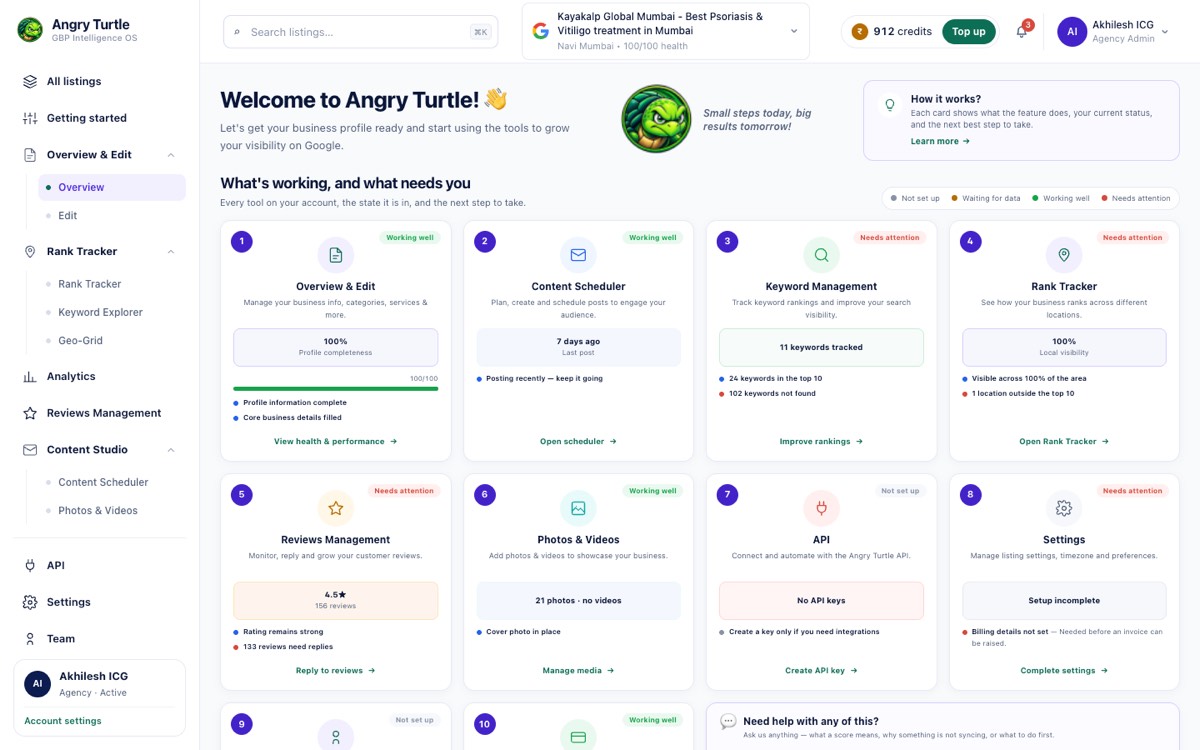

Related reading
Ready to have this run for you?
Book a free audit — we'll show you where you stand in 48 hours.