 Angryturtle
The 13-Point Local SEO Checklist for Indian Dental Clinics
A single-chair practice and a six-chair multi-speciality clinic need different things. Work down the list in order.
Work down this checklist in order. It's sequenced deliberately — the first few items fix problems that make everything after them pointless, and the later items are refinements that only matter once the basics are solid.
1. Claim and verify the Google Business Profile
An unclaimed listing carries whatever auto-generated information Google assembled from other sources, often wrong — sometimes an old address, sometimes a phone number that no longer connects to the clinic. Verification for a dental practice can take longer than for a retail business, so this has to happen before anything else on this list matters, because none of the later fixes take effect on an unclaimed profile. See the exact process in our how-to on claiming and verifying a Google Business Profile.
2. Set the primary category to a specific dental type, not generic "Dentist"
"Dentist" works, but "Cosmetic Dentist," "Pediatric Dentist," or "Orthodontist" as the primary category — where accurate — captures speciality search intent that a generic category loses, because Google's category filters treat these as distinct search buckets rather than synonyms. A six-chair multi-speciality clinic should use secondary categories to cover its full range once the primary is set correctly; a single-chair general dentist should stay with the generic category if that's genuinely what the practice offers, rather than picking a speciality category to sound more specialised than it is. See how to choose a GBP category for the full decision process.
3. Match the business name exactly to what's on the clinic's signage and prescription pad
Adding extra keywords to the GBP name that aren't part of the real business name violates Google's guidelines and risks suspension — a risk not worth the marginal keyword boost it might offer anyway, and a suspended listing during a busy season costs far more than any keyword stuffing could have gained. A name that drifts across GBP, Practo, and the clinic's own signage also creates a NAP consistency problem that compounds every time the clinic gets listed somewhere new.
4. List every service the clinic actually offers, not a copy-pasted generic dental services list
A single-chair general dentist who doesn't do orthodontics or implants shouldn't list those services just because a template suggested them — an inaccurate services list creates search matches for procedures the clinic can't actually deliver, which produces disappointed calls, not patients, and it also damages the clinic's rating indirectly when those mismatched calls become frustrated one-star reviews from people who were never a real fit in the first place.
5. Set accurate hours, including lunch breaks and any day the clinic closes early
Dental clinics often close for a midday break that varies by day. If GBP hours don't reflect that, patients show up to a locked door during what the listing claims is open time, and that specific kind of mismatch — appearing open when actually closed — is one of the fastest ways to generate a review that costs more trust than the listing gained by looking open longer.
6. Write a description in plain language about what the clinic actually treats
A single-chair dentist focused on routine care and basic procedures should say so plainly; a multi-speciality clinic offering implants, root canals, and orthodontics should name those specifically. Keep every claim within what's permitted — no outcome or comparison claims. A description this specific also does double duty by feeding the relevance dimension of how a profile gets scored against category peers in the same locality.
7. Upload real photos of the actual chairs, waiting area, and equipment
This matters more for dental than for most healthcare categories, because dental anxiety is common and patients specifically look for photos that suggest a calm, modern, clean setup before booking. A gallery of stock photos, or worse, no photos at all, leaves exactly the anxious first-time patient with nothing to judge the clinic by except price and star rating, which pushes the decision toward whichever competitor did bother to upload real photos.
8. Set up a Practo listing and keep the fee and availability information current
For dental specifically, Practo drives a meaningful share of comparison-shopping traffic — patients checking multiple clinics' pricing transparency and reviews before booking a first appointment. A Practo listing that's stale on availability or fee display loses that comparison-stage visibility to a competitor whose listing is current, even if the actual clinic is otherwise comparable or better.
9. Ask for a review right after a routine visit goes well, not weeks later
A same-day WhatsApp request with a direct review link converts far better than a delayed bulk message, and dental visits — being generally routine and low-anxiety once completed — are a good moment to ask, unlike some other specialties where the timing is more delicate. Review velocity that grows steadily this way outperforms a burst campaign that spikes once and then goes quiet, a full breakdown of which is in our how-to on getting more Google reviews.
10. Reply to every review without confirming any specific treatment
A reply thanking a patient for trusting the clinic with their "root canal" confirms, publicly, that a named person had that specific procedure. Keep replies generic and thankful regardless of what detail the patient's own review mentions — the fuller reasoning behind this, and the habits that apply across a whole clinic's review base, are covered in our compliant review habits guide.
11. Check NAP consistency between GBP, Practo, and the clinic's own website footer
A phone number that's current on GBP but outdated on the website footer, or a clinic name spelled slightly differently across platforms, weakens entity authority in exactly the way that quietly suppresses visibility over time — not through any single dramatic penalty, but through Google treating what should be one trusted entity as two uncertain ones.
12. Post about actual clinic updates, not generic dental-hygiene tips
New equipment, an added specialist joining the practice, or a holiday closure are the kind of specific, checkable content that both patients and answer engines respond to better than a rotating library of stock "brush twice a day" advice, which every other dental clinic's account is also posting and which answers nothing specific to this particular practice.
13. Add basic structured information to the clinic's own website if it has one
Hours, address, and services should match GBP exactly. This isn't strictly a GBP task, but a website with mismatched hours or address undermines the trust the GBP listing has otherwise built, and it's an easy fix once someone actually checks — a patient who notices the mismatch between the website and the listing tends to trust neither afterward.
A single-chair general practice can complete items one through nine and get most of the practical benefit — verification, category, name accuracy, services, hours, description, photos, Practo, and review timing cover the bulk of what drives new patient calls. A six-chair multi-speciality clinic in Bengaluru, Pune, or Gurgaon needs the full thirteen, particularly the NAP consistency check and the website match, because more moving pieces means more places for small inconsistencies to accumulate.
FAQ
Does a single-chair dentist need every item on this list? No — items one through nine cover most of the practical benefit for a small practice; the later items matter more once a clinic has multiple providers, multiple service lines, or its own separate website to keep in sync.
Why does category accuracy matter more for dental than some other specialties? Because dental has clear, well-searched sub-specialities — cosmetic, pediatric, orthodontic — that patients search by name specifically, so a generic "Dentist" category alone leaves that specific search intent uncaptured.
How often should this checklist be revisited? A full pass whenever the clinic adds a service, hires a new specialist, changes hours, or moves location — plus a quick NAP consistency check every few months regardless of whether anything obvious has changed.
Is Practo worth the ongoing effort for a small dental practice? Yes, more so than for many other specialities, because dental patients frequently comparison-shop on visible fee ranges and reviews before booking a first visit, which Practo's format supports directly.
What's the single highest-impact item on this list for a brand-new listing? Verification and category accuracy together — nothing else on the list functions properly until the listing is verified and correctly categorised.
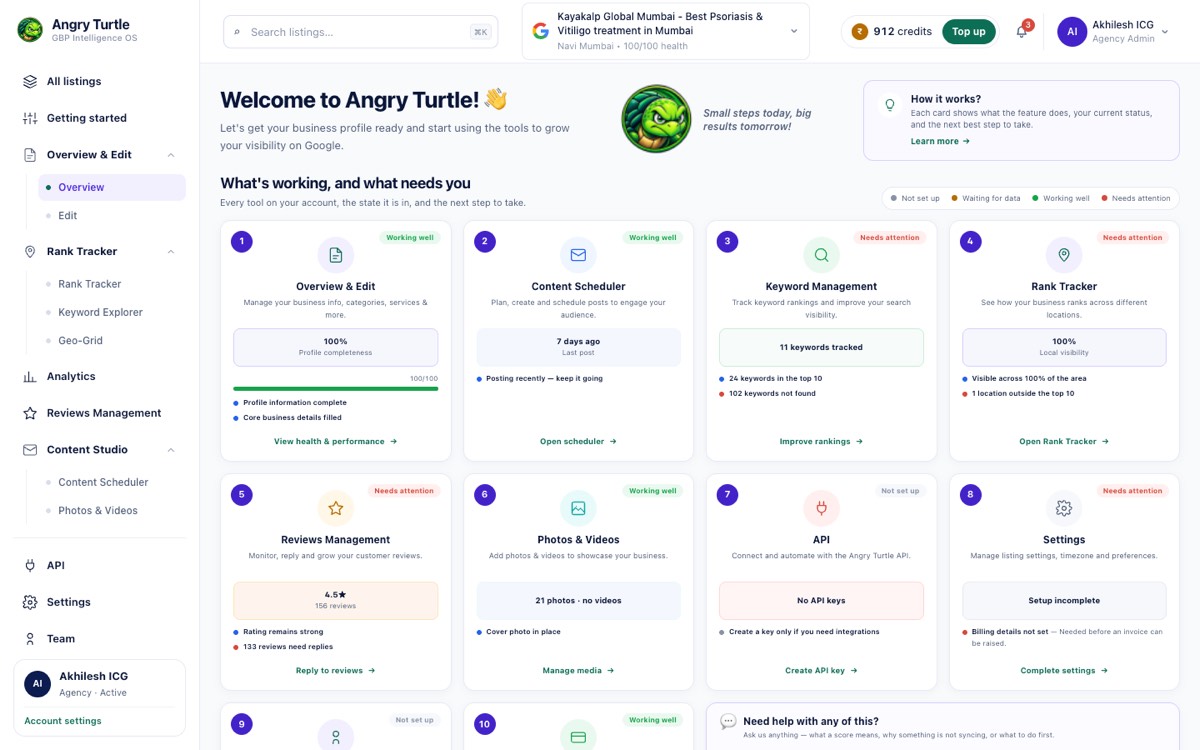
Angryturtle's Profile Elements grid scores every field on a listing by presence, risk, and ranking impact, which turns a checklist like this into a ranked, ongoing action plan rather than a one-time task, running underneath Rank OS alongside citation checks across 20+ platforms. See related reading on local SEO tactics for individual doctors and the fourteen directories that matter for doctors and clinics, check the healthcare industry page, see pricing, or contact us to book a free audit.
More listicles and rankings
A score you can argue with, not a black box
Rank OS gives every profile a 0–100 score built from five weighted dimensions — Relevance, Review Health, Freshness, Entity Authority and AIO Readiness — and the weights are tunable. Underneath it sits a ranked list of the fixes that move the number, each with the point lift it unlocks.
Ready to have this run for you?
Book a free audit — we'll show you where you stand in 48 hours.