 Angryturtle
Local SEO tools an Indian agency actually needs
The tool categories worth an Indian agency's budget, and the ones worth skipping.
The category question, not the tool question
An agency running local SEO for ten or twenty Indian clients doesn't fail because it picked the wrong rank tracker. It fails because nobody sat down and decided which categories of tool actually earn their monthly cost for an India-first client roster, versus which ones were bought because a competitor mentioned them on LinkedIn. This list works category by category. Pricing, feature counts and "best of" rankings for named products change monthly and this piece won't guess at them. Check any vendor's own site before signing anything.
Six categories cover almost everything an Indian local SEO agency needs. A seventh — the stuff worth skipping — matters just as much as the six.
GBP and location data management
This is the category most agencies underinvest in relative to how much client damage a bad profile causes. A location data tool should let a team edit a listing centrally and push the correction live, catch duplicate listings before a client's customer does, and cover Indian directories like JustDial, Sulekha and Practo alongside Google itself. The location data management page walks through what "good" looks like in this category, and the location data management tools roundup covers specific platforms and where each one is strong or thin on Indian coverage.
For an agency managing more than a handful of locations per client, duplicate detection alone justifies the category. A clinic chain with three staff-created duplicate GBP listings will keep generating the same NAP complaint every month until something actually merges them, not just flags them. Duplicate listings cleanup and managing 100+ GBP listings both cover what this looks like once a roster grows past a dozen locations.
Citation and directory management
Citation tools built for the US and Europe treat Indian directories as an afterthought, and that gap is exactly where an agency's clients lose ground. JustDial and Sulekha carry real discovery volume independent of Google; Practo matters specifically for healthcare clients, IndiaMART for B2B. Top Indian directories for local SEO is worth reading before buying anything in this category, because it names which directories are actually worth an agency's time by business type rather than assuming every listing helps every client equally.
Consistency matters more than volume here. A tool that adds a business to forty directories with three different phone number formats has made the problem worse, not better. Fixing NAP across directories and NAP consistency at scale both cover the mechanics of getting this right once an agency runs the same cleanup across dozens of client accounts.
Rank tracking
Rank tracking tells an agency where a client sits for a given keyword in a given location, and that's genuinely useful for reporting even though it says nothing about why a ranking moved. Grid-based local rank trackers, which sample a keyword across a geographic grid rather than one point, are worth the extra cost for any client competing on a map pack rather than a single organic result. The geo grid glossary entry explains why a single-point rank check misses most of what actually matters for map pack visibility.
An agency should be honest with itself about what rank tracking is for. It's a diagnostic and a reporting input, not a growth lever on its own, and a tool vendor promising that tracking alone will move rankings is selling something it can't deliver.
Review management
Review volume, velocity and response rate all feed into local ranking signal, and a review management tool that automates requests and centralizes responses saves real hours across a multi-client roster. Review generation strategy covers the sequencing question that trips up a lot of agencies: building schema and content before the underlying review base can support it wastes the investment, because a thin review base caps how much any other work can achieve.
Multi-location clients need per-location review targets, not one shared pool that flatters the average while individual branches sit thin. Reviews and multi-location governance covers structuring this properly, and review response templates is a starting point for the reply cadence an agency needs to keep up across every client account, not just the flagship ones.
Schema and structured data
An agency serving Indian clients across healthcare, real estate and education needs to get comfortable with LocalBusiness schema and its industry-specific variants, because Google and AI answer engines both lean on structured data to understand what a business is and where it operates. The structured data glossary entry and LocalBusiness schema glossary entry cover the baseline, and schema for healthcare vs real estate vs education covers the differences that actually matter once an agency is deploying schema across a mixed client roster rather than one vertical.
Most agencies don't need a developer-grade schema tool. A generator that produces valid JSON-LD for the handful of schema types an Indian local SEO client actually needs, checked against Google's own testing tools before it ships, covers the category adequately.
Reporting and dashboards
Client reporting is the category agencies build the most bespoke tooling around, usually a spreadsheet stitched to a handful of API pulls, because most off-the-shelf dashboards weren't designed around the KPIs that actually matter for Indian local SEO. Local SEO KPIs and reporting to clients both cover what a report should actually contain rather than what a generic template defaults to.
Whatever tool an agency picks here, it should make the gap between "what we tracked" and "what actually happened for the client's business" visible, not paper over it with vanity metrics. A ranking chart that goes up while a client's phone doesn't ring is a reporting failure, not a success story.
What to skip
A few categories get bought reflexively and rarely earn their cost for a typical Indian agency roster. Enterprise knowledge-graph platforms built for hundred-location Western retail chains are usually overkill and underconfigured for Indian directory coverage — the Yext comparison covers this specifically. Generic social media schedulers rebranded as "local marketing suites" tend to handle GBP posts as an afterthought bolted onto Instagram and Facebook scheduling, and the GBP-specific side of that work usually needs its own tool anyway; see GBP post ideas for what that actually requires. And standalone AI-visibility trackers that only cover ChatGPT, with no Google or Indian-directory data, give an incomplete picture on their own — share of AI voice covers what a fuller measurement approach looks like.
Where a platform beats a stack
Most agencies start by stitching these categories together as separate subscriptions, and it works until a location count grows past what a spreadsheet can track cleanly. At that point the cost isn't the tool subscriptions, it's the hours spent reconciling six dashboards that don't talk to each other.
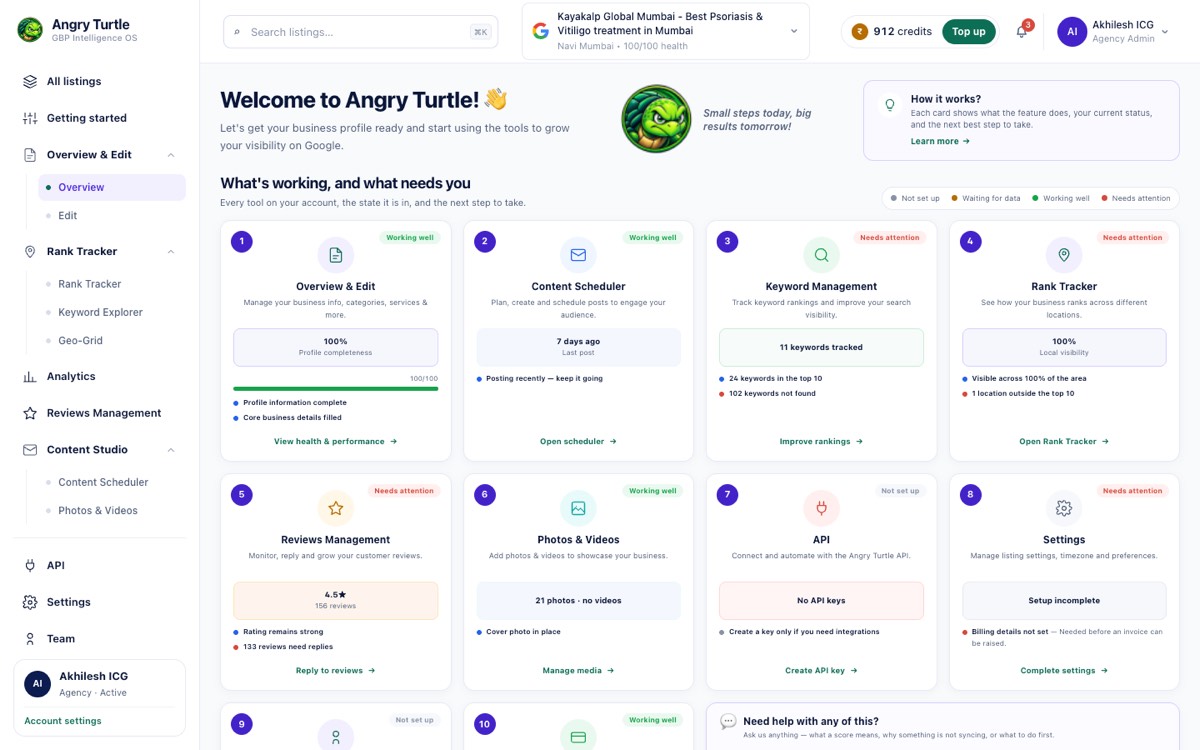
Angryturtle's Agency OS is built for agencies managing this across a multi-client roster from one place — GBP management, review tracking, citation consistency and reporting under one login instead of six. Rank OS handles the diagnostic layer underneath it, scoring every client profile across weighted risk dimensions and queuing fixes rather than just flagging problems. For agencies that want to hand the execution layer off entirely rather than run it themselves, white-label local SEO and multi-location local SEO services cover the managed side of the same platform. It isn't a different product for a different scale of client, just a different way of using the same one.
FAQ
Do Indian agencies need a different local SEO tool stack than US or European agencies? Mostly in the directory and citation category. Rank tracking, review management and schema tools work similarly everywhere, but citation coverage needs to include JustDial, Sulekha, Practo and IndiaMART, which most global citation platforms treat as an afterthought if they cover them at all.
Is a free local SEO tool ever enough for agency work? For a single client with one location, sometimes. Free local SEO tools covers what's genuinely usable versus what's a lead-gen funnel disguised as a tool. Past two or three clients, the manual reconciliation work usually costs more in hours than a paid platform would.
How many separate tools does a typical Indian agency need? There's no fixed number, and any answer claiming otherwise is guessing. What matters is whether the categories above are covered by something, not how many logins it takes to cover them. Fewer platforms that talk to each other beats more platforms that don't.
Can a rank tracking tool guarantee ranking improvements? No credible one can, because no vendor controls Google's algorithm. A rank tracker measures position; it doesn't cause a change in position.
What's the biggest tooling mistake agencies make when scaling past ten clients? Buying a bigger version of the same single-client tool instead of a platform designed for multi-client, multi-location management from the start. The symptoms show up as reporting inconsistency and duplicate listings nobody caught before a client noticed.
More listicles and rankings
A score you can argue with, not a black box
Rank OS gives every profile a 0–100 score built from five weighted dimensions — Relevance, Review Health, Freshness, Entity Authority and AIO Readiness — and the weights are tunable. Underneath it sits a ranked list of the fixes that move the number, each with the point lift it unlocks.
Ready to have this run for you?
Book a free audit — we'll show you where you stand in 48 hours.