 Angryturtle
Healthcare SEO in Kolkata: A Practical Guide for Clinics and Hospitals
·
Kolkata's healthcare search behaviour has one quirk that trips up most SEO advice written for Mumbai or Delhi: Practo carries an outsized share of the discovery journey here, ahead of a straight Google Maps search, for a large slice of specialist appointments. A dermatologist in Salt Lake or a paediatrician in Ballygunge who ignores that is optimising for the wrong front door. This is a practical guide to healthcare SEO in Kolkata — what actually moves a clinic or hospital up the local pack, what separates an agency that understands this market from one running a national template with the city name swapped in, and what's specific to Kolkata rather than copied from a generic playbook. Whether the search that brought you here was healthcare SEO services in Kolkata, a healthcare SEO agency in Kolkata, the best healthcare SEO services in Kolkata, a healthcare SEO company in Kolkata, healthcare SEO in Kolkata generally, or a medical SEO agency in Kolkata, the underlying evaluation and the underlying fixes are the same, and this page walks through both.
Healthcare search in Kolkata also runs on a mix of English and Bengali, plus transliterated Bengali typed in Roman script. Someone searching "dentist near me," someone searching "daanter daktar," and someone searching "কাছাকাছি ডেন্টিস্ট" are the same intent, but Google treats the three differently, and most clinic profiles have done nothing about the second or third version. That gap alone is worth fixing before touching anything else on this list, and it's one of several things a Kolkata-specific evaluation catches that a generic one won't.
Contents
- What separates a healthcare SEO agency that actually works in Kolkata
- The Kolkata healthcare landscape, locality by locality
- Category accuracy first, always
- Bengali and transliterated search: what patients actually type
- Why Practo changes the playbook here
- JustDial, Lybrate, and NAP consistency across all of them
- Reviews, in two languages
- Compliance: what a clinic and its agency may not do
- Managing multi-department complexity
- Schema, structured data, and what it actually buys a Kolkata clinic
- AI search is starting to change how patients ask
- Worked scenario: a two-doctor dermatology practice in Salt Lake
- What actually goes wrong without this
- What to ask before you sign with anyone
- What the engagement actually looks like, month to month
- What separates the best healthcare SEO services in Kolkata from generic agency work
- Where this isn't the right fit
- What Angryturtle actually does here
- Frequently asked questions
What separates a healthcare SEO agency that actually works in Kolkata
Most agencies pitching healthcare SEO services in Kolkata run the same national playbook they'd run for a clinic in Pune or Jaipur, with the city name changed in the proposal. That playbook usually gets category selection and basic citation cleanup right, because those are the same everywhere. It usually misses everything that's actually Kolkata-specific: Practo as a parallel discovery channel with its own review pool and its own stale-listing risk, Bengali as a live lever for review volume rather than an afterthought, and a locality structure — Salt Lake against New Town, Ballygunge against Gariahat, Howrah as something closer to its own market than a neighbourhood — that changes who a given clinic is actually competing against.
A useful test before signing anything: ask the agency to name, unprompted, which platform patients in this city check before Google Maps for a specialist appointment. If the answer is "Google Business Profile is the main thing," they haven't worked a Kolkata healthcare account before, or they worked one and didn't notice. Ask a second question — what changes about the review-collection script for a Bengali-speaking patient base — and listen for whether the answer is a real workflow or a shrug.
The engagement itself should be legible from week one. A category and profile audit comes first, because it's the cheapest fix with the clearest payoff and it tells you fast whether the provider actually looked at your specific listing or sent a templated report. NAP consistency across Google, Practo, JustDial, and the smaller directories comes next. Review generation and response follow, with the compliance constraints below built into the process rather than bolted on after a complaint. Structured data and freshness — posts, photos, Q&A — round it out. None of this is exotic. What's exotic is doing it with Kolkata's actual discovery pattern in mind instead of a generic one.
The Kolkata healthcare landscape, locality by locality
Kolkata's private hospital market is dominated by a handful of large groups clustered mainly along EM Bypass, where the big multi-speciality hospitals sit and compete on emergency capacity, bed count, and specialist depth more than on local SEO fundamentals — their scale carries them past most of the mistakes a smaller clinic can't afford to make. Salt Lake and New Town are the newer growth corridors, where multi-speciality clinics and diagnostic chains have opened in the last several years, competing on a mostly level footing because none of them has the decade of accumulated reviews an older Ballygunge practice has. Ballygunge and Gariahat run the opposite pattern: established single- or two-doctor practices, often decades old, with loyal local followings and GBP listings that were claimed once in 2019 and never touched again. Behala and Howrah are neighbourhood-clinic territory — GPs, dentists, physiotherapists serving walk-in traffic from the immediate area, where reputation still travels mostly by word of mouth and a Google listing matters more for confirming what a neighbour already told you than for cold discovery.
That density matters for local SEO because relevance and proximity, two of the three local ranking factors, get compressed into a very tight geography. A GP in Gariahat isn't really competing against a GP in New Town for the same "doctor near me" search — the map pack for that query in New Town won't include Gariahat results at all. What that GP is actually up against is every other GP, polyclinic, and hospital OPD desk within about a kilometre and a half, several of which have hundreds of reviews and a category set up correctly. Winning that specific radius is the entire game, and a Salt Lake multi-speciality clinic is not fighting the same battle a Ballygunge single-doctor practice is fighting, even though both show up under the same "Kolkata" city label.
Howrah is its own case again — separated from central Kolkata by the river, with search behaviour and directory strength that look closer to a satellite city than a neighbourhood of Kolkata proper. A clinic there is rarely competing against a Salt Lake or Ballygunge practice at all, whatever the shared "Kolkata" label on Google Maps implies. An agency that treats Howrah as interchangeable with EM Bypass, or that recommends the same review-volume target for a Behala neighbourhood clinic that it would for a New Town multi-speciality centre, hasn't actually looked at what each of these markets requires to win.
Category accuracy first, always
Get this wrong and nothing else on this page will help. A general physician listed simply as "Doctor" is competing with every category of medical practice in the neighbourhood for a query it should win outright; the fix is picking the closest specific category — General Practitioner, Dermatologist, Orthodontist — and layering relevant secondary categories on top, the same principle covered in full in how to choose the right GBP category. Healthcare has one added wrinkle: Google reviews medical-category listings more strictly than most verticals, so a mismatch between the chosen category and what a clinic can actually document (registration, staffing, physical premises) risks a suspension flag rather than just a relevance problem, on top of the deeper detail in our GBP suspension reasons rundown.
Bengali and transliterated search: what patients actually type
Most clinic profiles are built and optimised entirely in formal English. Most patients aren't searching that way. Real query shapes that show up in Kolkata healthcare search include "daanter daktar" for a dentist, "chokher daktar" for an ophthalmologist, and "hasptal near me" — English word, Bengali word, mixed freely and typed in Roman script rather than Bengali script most of the time. Someone searching "কাছাকাছি ডেন্টিস্ট" in Bengali script is a smaller but real slice of the same demand.
Before: a dental clinic's GBP profile lists the category as "Dental Clinic," a services list reading "General Dentistry, Cosmetic Dentistry," and a business description written entirely in English. It ranks fine for "dentist Gariahat" and effectively doesn't exist for "daanter daktar Gariahat," because nothing in the structured fields or the description gives Google anything to match against a transliterated query.
After: the same profile keeps the English category and services list, because that's what Google's category picker requires, but the business description adds a line naming the practice in transliterated form once — something like "Gariahat-e daanter daktar, general o cosmetic dentistry" — and the FAQ content on the linked page answers a question phrased the way a patient would actually type it, not the way a copywriter would phrase it. That's the whole fix. It's a content and description change, not a rebuild, and it closes a gap that formal-English-only profiles leave open across the board.
Category selection and the services list are where this matters structurally, because those are fields a model reads directly rather than inferring from prose. A clinic doesn't need bilingual everything. It needs the specific fields that get parsed to actually contain the words patients use.
Why Practo changes the playbook here
In most Indian cities, Google's local pack is the first stop for a healthcare search. In Kolkata, and to a similar degree in a few other metros, a meaningful share of specialist appointment discovery happens on Practo before the patient ever opens Google Maps — a doctor picking a specialty and a locality, comparing consultation fees, and reading Practo-specific reviews that never touch Google at all. A clinic's Google Business Profile can be immaculate and still lose bookings if its Practo listing is thin, its fee information is outdated, or its Practo reviews haven't been actively managed.
This is the single biggest thing a generic SEO agency misses about this city. A provider that treats Practo as an optional extra, worth a mention in month three if there's time, is running the wrong scope for a Kolkata healthcare account from day one.
JustDial, Lybrate, and NAP consistency across all of them
JustDial still matters for a different slice of the same problem, especially for walk-in-oriented practices — GPs, dentists, physiotherapy clinics — where a phone call rather than an online booking is still how a meaningful share of Kolkata patients make first contact. Lybrate carries some weight for online consultation and second-opinion searches specifically, a narrower slice than Practo but not zero, and worth a completed profile rather than an abandoned one if the clinic offers any tele-consultation option at all.
The practical implication is that healthcare SEO in Kolkata isn't a single-platform job. NAP consistency needs to hold across Google, Practo, JustDial, and the general citation layer described in NAP consistency at scale — a phone number that's live on Google but disconnected on Practo, or a clinic address that changed on one platform and not the other, quietly bleeds appointments on whichever platform is stale. This matters more here than in most metros precisely because Kolkata patients genuinely cross-check between Google and Practo before booking rather than defaulting to one; a mismatch they notice reads as a business that isn't paying attention, which is a worse signal for a healthcare decision than for most other purchases.
Reviews, in two languages
Review volume and rating matter the way they do anywhere, covered at length in how reviews affect AI search visibility, but Kolkata clinics get an extra lever most guides skip: a meaningful share of patients will write a review in Bengali if simply asked to, rather than defaulting to English because that's what the request form implies. A front-desk process that asks "Google-এ একটা review লিখে দিতে পারবেন?" alongside the English version tends to pull in reviews from an older, more comfortable-in-Bengali patient demographic that otherwise skips leaving feedback entirely — and those reviews still carry the same weight in Google's review signal regardless of language.
Responding matters too, and responding in the language the review was written in reads as attentive rather than templated. A generic English reply pasted under a Bengali review is a small but visible tell that nobody actually read it.
Compliance: what a clinic and its agency may not do
Indian medical advertising norms limit what a clinic may claim in its own marketing and what a review reply may confirm in public, and this constrains healthcare SEO more than it constrains most other verticals. A review reply must never confirm that the reviewer was a patient, must never discuss a specific condition or treatment, and must never argue clinical facts in a public thread — even in response to a negative review that gets the facts wrong. The safe pattern is to acknowledge the review, state the general standard the practice holds itself to, and move any specifics to a named offline contact.
The same discipline applies to content and GBP posts. No claims of guaranteed outcomes, no before-and-after framing implying a specific result, no comparative claims against a named competitor's clinical quality. This isn't a workaround-able constraint and no agency should present it as one; a healthcare SEO provider that offers to write patient-outcome claims, or drafts review replies that confirm a patient's condition, is offering something that creates real regulatory and reputational risk for the clinic, not a competitive edge.
Managing multi-department complexity
Kolkata clinics that have grown into small multi-specialty setups — a general practice that added a diagnostic wing, or a dental clinic that brought on an orthodontist and a paediatric dentist — run into the same structural question every growing healthcare business hits: one GBP listing trying to represent several distinct services under one category and one set of hours. The short version for a single-site, multi-department Kolkata clinic is to keep one primary listing with the dominant service as the primary category and every genuine sub-specialty added as a secondary category, and to make sure the services list and GBP Q&A spell out each specialty by name rather than leaving Google to infer it from a business name alone. Hospital SEO in India covers the harder version of this problem — genuinely separate departments, each drawing different search intent — in the piece on hospital SEO in India, worth reading in full for any Kolkata hospital past the single-department stage.
Schema, structured data, and what it actually buys a Kolkata clinic
Structured data won't move rank on its own, but it does make a clinic a cleaner, more citable source when Google, Practo's own search, or an AI system is trying to answer "best paediatrician near Salt Lake" — see schema markup for AI search for the full mechanism. For a healthcare listing specifically, that means MedicalBusiness or Physician schema with a correct specialty, address, and hours, plus FAQPage schema wrapping the clinic's actual FAQ content rather than a copy-pasted generic block. None of this replaces a correct category or real reviews. It's the layer that sits on top of both once they're right.
AI search is starting to change how patients ask
A patient typing "which dermatologist in Kolkata treats acne scarring" into an AI assistant is asking a more specific question than the old "dermatologist near me" search, and AI systems answer it by pulling together a business's category accuracy, review content, and structured data rather than ranking ten blue links — the mechanism is laid out in AI overviews and local business in India and, at the country level, in the AEO playbook for India. Kolkata healthcare providers who get category, reviews, and schema right for ordinary Google search are largely already positioned for this, which is one more reason to fix the fundamentals before chasing anything more exotic. The programmatic hub at /local-seo/kolkata/healthcare tracks Kolkata-specific healthcare search demand if you want to see what the cluster looks like at a glance, alongside the city-wide view at /local-seo/kolkata.
Worked scenario: a two-doctor dermatology practice in Salt Lake
A two-doctor dermatology practice in Salt Lake, open four years, doing steady walk-in business, has never touched its Google Business Profile beyond the initial setup. Its category has sat as plain "Doctor" the whole time. Reviews sit at a respectable number but almost all in English, despite roughly half the patient base clearly more comfortable in Bengali based on how they talk at the front desk. Its Practo listing exists but hasn't been updated since 2023 and still lists a doctor who left the practice eighteen months ago.
The constraint here isn't budget — a two-doctor Salt Lake practice isn't going to fund a large ongoing retainer. It's that neither doctor has time to run a citation sweep or a review campaign personally. The defensible recommendation for a practice at exactly this size and constraint is a bounded, front-loaded fix rather than an open-ended monthly engagement: correct the category to Dermatologist with the right secondary categories, update and verify the Practo listing including removing the departed doctor, add Bengali to the review-ask script at the front desk, and add MedicalBusiness schema with FAQPage content answering the specific acne-scarring and pigmentation questions patients actually ask. That's a two-to-three-week project, not a retainer, and it's the right scope for this specific practice's size and time constraint. A larger multi-department hospital with the same starting problems would need the ongoing managed relationship described further down this page instead.
What actually goes wrong without this
A clinic's category sits as generic "Doctor" for years because nobody realised it was ever set that way, and it quietly loses every specialty-specific search to a competitor two streets over who picked Dermatologist correctly on day one. A Practo listing goes stale after a doctor leaves the practice, and a patient books an appointment expecting to see a specialist who hasn't worked there in over a year, showing up to a confused front desk and leaving a one-star review that has nothing to do with the actual care quality. A front desk keeps asking every patient for a Google review in English only, and the clinic's total review count stays flat for years relative to a competing practice down the road that started asking in Bengali too and doubled its review volume in a fraction of the time.
What to ask before you sign with anyone
A Kolkata clinic sizing up healthcare SEO services shouldn't need to take an agency's word for anything that can be checked directly, and there's a short list of things worth confirming before money changes hands.
Search the clinic's own name on Google Maps and read what category shows underneath it — that's the starting point any proposal should reference specifically, not generically. Open the Practo listing and check the last-updated date and whether every doctor still practising there is actually listed. Ask the front desk, honestly, how often anyone requests a review in Bengali versus only in English. Ask the agency to show what a monthly report actually looks like, not describe it — a vague answer here usually means the reporting is thin. Ask what evidence they'd bring to a suspended-listing appeal if one happened, because a provider who can't answer that hasn't handled a healthcare suspension before, and healthcare listings get flagged more often than most other categories.
None of these take more than five minutes, and together they tell you more about where the gaps actually are, and about whether a given agency actually understands this market, than a sales pitch will.
What the engagement actually looks like, month to month
A properly scoped healthcare SEO engagement in Kolkata isn't a mystery box. Month one is an audit and the fixes that don't require ongoing work: category correction, Practo and JustDial cleanup, schema implementation, a corrected services list. Month two shifts to the review-generation workflow going live — the front-desk script, the QR or link kit, response templates that respect the compliance line above — and to the first round of GBP posts and photo updates. From month three onward the work becomes maintenance and measurement: fresh posts on a schedule, review responses within a day or two, freshness signals that don't lapse, and a monthly report showing where the listing stands against named neighbourhood competitors rather than an abstract national benchmark.
There's no timeline promise attached to any of this, because none is honest to make — Google's own review and ranking process for healthcare listings moves on its own schedule, not an agency's. What a properly run engagement can promise is that the fundamentals get done correctly and stay correct, which is the entire lever anyone actually controls.
What separates the best healthcare SEO services in Kolkata from generic agency work
Most SEO vendors selling into Kolkata run the same national playbook regardless of city, which misses the two things that actually matter here: Practo as a parallel discovery channel to Google, and Bengali as a live review-collection lever rather than an afterthought. A healthcare SEO agency in Kolkata that can't name the difference between Salt Lake's competitive density and Howrah's separate market, or that treats Practo as an optional extra rather than core scope, is running the Mumbai or Bangalore version of this work with the city name swapped in. Whether the right choice is a full-service healthcare SEO company in Kolkata or a narrower managed GBP engagement depends mostly on whether the clinic also needs website, content, or paid-search work handled, or just wants its Google and Practo presence run correctly.
Where this isn't the right fit
None of the above is a substitute for a clinic actually being good — no category fix or Bengali review script overcomes a genuinely bad patient experience for long, and any agency claiming otherwise is overselling. A single practitioner seeing a handful of patients a week, with no ambition to grow appointment volume, may reasonably decide the current setup is good enough and skip a formal engagement entirely. The fixes described here pay off fastest for a practice that's already busy enough to be losing bookings to search-visibility gaps rather than to capacity, and slowest for one that's genuinely capacity-constrained already — more visibility just means a longer wait list.
What Angryturtle actually does here
None of the above requires a tool to execute manually — a solo dermatologist can work through category selection, a Practo cleanup, and a Bengali-language review ask in an afternoon. Where a platform earns its keep is in scoring where a specific Kolkata listing actually stands against neighbourhood competitors and keeping it there over time. Angryturtle's Rank OS weighs relevance, review health, freshness, entity authority, and AIO readiness — the same categories this guide has walked through — into a single score with a ranked action list. Geo-grid tracking shows rank at every point across Salt Lake, Gariahat, or Howrah separately rather than one averaged city number, which matters given how locally the competition actually plays out here.
For clinics that would rather have the fixes made than made-to-do, managed GBP services cover category audits, review workflows built around the compliance constraints above, AI-drafted review replies with human sign-off before anything publishes, citation and NAP cleanup across the directories that actually carry weight in Kolkata, scheduled GBP posts, and direct write-back to Google for clinics managing more than one location. Insights and performance reporting and Ask Maps / AIO readiness round out the ongoing measurement. If a listing has already been suspended, the GBP reinstatement service and the companion guide on writing a GBP reinstatement appeal cover what the appeal needs.
See the healthcare industry page and the deeper healthcare local SEO playbook and healthcare AI search readiness pages for how the platform adapts its cluster taxonomy specifically for medical practices, and the pricing page for what a managed engagement or self-serve plan actually costs. Angryturtle manages 319 Google Business Profiles across eight industries, healthcare among them. For clinics wanting a broader directory checklist before engaging anyone, the listicles on local SEO tips for doctors in India, directories for doctors and clinics in India, review management for clinics in India, the local SEO checklist for dental clinics in India, and GBP tips for hospitals in India cover adjacent ground worth reading. To talk through a specific listing, book a demo or get in touch.
This is general guidance, not medical or legal advice, and nothing here guarantees a specific rank position — Google's local algorithm and its review process for healthcare listings are both outside any tool's or agency's control. What's controllable is doing the fundamentals correctly and consistently, which is most of what separates a clinic that shows up and one that doesn't.
Frequently asked questions
Does Google treat healthcare GBP listings differently from other businesses? Yes. Medical-category listings go through stricter review, particularly around category accuracy and identity verification, because Google treats health-related information as a higher-risk area. A category that doesn't match what the business can document is more likely to trigger a suspension flag here than in most other verticals.
Should a Kolkata clinic prioritise Google or Practo? Both, because they're solving different parts of the discovery journey. Google Maps still drives a large share of "near me" searches for general practice and walk-in-adjacent care; Practo carries more weight specifically for appointment-based specialist bookings. Treat them as one consistent presence rather than picking a favourite.
Do Bengali-language reviews carry different weight than English ones on Google? No — Google's review signal doesn't weight by language. The value of encouraging Bengali reviews isn't a ranking trick, it's that it reaches patients who'd otherwise skip leaving a review at all, which increases total review volume and velocity.
How long does it take to see movement after fixing GBP category and reviews? Category corrections can show up in discovery search impressions within days to a few weeks, visible in GBP Insights. Review-driven improvement is slower and compounds over months, since it depends on rating, volume, and velocity moving together rather than any single fix. No agency can honestly promise a specific timeline, because Google's own process moves on its own schedule.
Can a suspended healthcare GBP profile in Kolkata be reinstated? Often, yes, if the appeal is built around clear evidence that the listing accurately represents a real, correctly categorised practice. Our GBP reinstatement service and the companion guide on writing a GBP reinstatement appeal cover what that evidence needs to include, though Google alone makes the final call, and no service can guarantee an outcome.
Do JustDial and Lybrate actually matter for a Kolkata clinic, or is Google and Practo enough? JustDial still carries meaningful weight for walk-in-oriented practices where a phone call is the first point of contact, particularly outside the newer commercial pockets of the city. Lybrate matters less broadly but is worth a completed profile for any clinic offering tele-consultation, since it draws a specific online-consultation search intent that Google and Practo don't fully cover on their own.
Can a review reply confirm that someone was a patient, or discuss what they were treated for? No, and any agency willing to do that is taking on risk on the clinic's behalf without saying so. The safe pattern is to acknowledge the review, state the practice's general standard of care, and move specifics to a named offline contact — never confirm patient status or discuss a condition in a public reply.
What should a clinic ask before hiring a healthcare SEO agency in Kolkata? Ask whether they treat Practo as core scope or an afterthought, what their Bengali review-collection workflow actually looks like, what a monthly report looks like in practice rather than in description, and what evidence they'd assemble for a suspension appeal if one happened. A vague answer to any of these is worth weighing against the pitch.
Is a single monthly retainer the right structure for every Kolkata healthcare practice? No. A small, single-doctor practice with a specific, bounded set of fixes — category correction, a Practo cleanup, a review-language gap — often needs a short front-loaded project rather than an open-ended retainer. A multi-department hospital or a multi-branch diagnostic chain, with ongoing review volume and freshness needs across several locations, is the case where an ongoing managed engagement earns its cost.
Stop guessing where you rank locally.
Rank OS scores your Google Business Profile the way Google's local algorithm does — relevance, review health, freshness, entity authority and AIO readiness — and shows you exactly what to fix.
Book a live demo →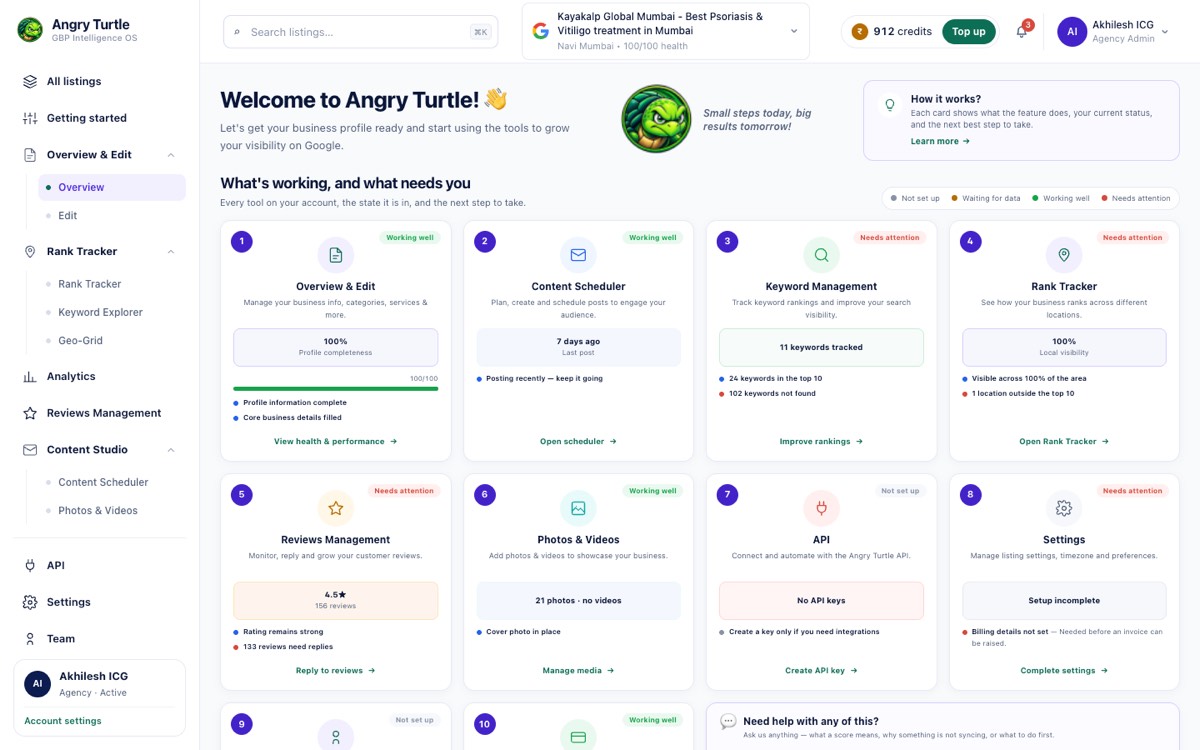

Related reading
Ready to have this run for you?
Book a free audit — we'll show you where you stand in 48 hours.