 Angryturtle
Local SEO in Mysore
The Mysore and Mysuru naming split, stage-and-block addressing, and locality search.
·
Search "Mysore" and "Mysuru" and you're describing the exact same market, but Google's local pack doesn't always agree with you. The city officially renamed itself in 2014, yet almost everyone still types "Mysore" into search bars, WhatsApp, and Google Maps, while signage, government paperwork, and a growing share of newer Google Business Profiles use "Mysuru." A clinic in Jayalakshmipuram that spells its own listing "Mysuru" but never mentions "Mysore" anywhere in its description or reviews is quietly opting out of most of its own search volume. This piece covers what actually makes local SEO in Mysore work or fail, a question that plays out differently across India's tier-2 cities, starting with that naming problem and moving into addressing, language, and industry-specific behaviour that a generic city page never touches.
The Mysore/Mysuru naming split isn't cosmetic
Treat this as a keyword decision, not a loyalty test. Businesses that pick one spelling and defend it, usually because an owner feels strongly that "Mysuru" is correct now, end up under-indexed for the other half of the query volume. The practical fix is boring: use "Mysore" as the primary spelling in your Google Business Profile name field (only if that's how you're legally registered — don't rename your business just for SEO), work "Mysuru" naturally into your description, service pages, and a few review responses, and never assume Google's own knowledge panel has reconciled the two for you. It often hasn't. A homestay near the palace that shows up under "Mysuru heritage stay" but not "Mysore homestay near palace," or the reverse, is losing bookings to a competitor who simply wrote both.
This also shows up in review text. A patient writing "best dentist in Mysore" and another writing "top dental clinic Mysuru" are the same customer type, but Google's ranking systems partly key off which terms actually appear in the content and reviews attached to a profile. Review sentiment and specificity matter here too — a review that names the locality reinforces the same terms a searcher types.
Addressing that breaks the pin
Mysore inherited a chunk of its city planning from the Bangalore convention: stage, block, and cross-and-main numbering layered over older localities that still go by name. An address in Vijayanagar 2nd Stage means something specific to a local courier but nothing to a delivery driver from Bengaluru dropped in cold, and Google Maps pins in these newer stages are frequently off by a full street, sometimes landing the marker on the wrong cross entirely. This is the same category of problem covered in fixing NAP inconsistency across Indian directories, except here the inconsistency is baked into the addressing system itself, not a data-entry error.
Kuvempunagar and Saraswathipuram compound this because both areas use a grid of numbered "blocks" that don't always run in the order a visitor expects — Block 1 and Block 2 aren't guaranteed to be adjacent. Gokulam, split into stages of its own, has a similar issue, and it's a locality where a lot of ayurveda and wellness centres cluster, which matters because those are exactly the businesses depending on first-time visitors finding them without a phone call for directions.
The fix that actually works is unglamorous: put the pin exactly where the entrance is, not where the building's postal address technically sits, then add the landmark in the GBP description itself — "opposite Devaraja market gate," "behind the RTO Vijayanagar" — because Mysore residents navigate by landmark first and address second, and so does a fair share of the "near me" search traffic coming in. Getting the map pack placement right depends on this pin accuracy more than most owners assume.
Localities and commercial districts worth naming
A city page that never says the words Vijayanagar, Kuvempunagar, Jayalakshmipuram, Gokulam, or Saraswathipuram by name is a page written about no particular place. Add to that Devaraja Mohalla and the areas around Sayyaji Rao Road for retail, Hebbal for newer residential and commercial growth, and the stretch near the Mysore Palace and Chamundi Hill for anything tourism-adjacent. Silk and sandalwood retailers cluster heavily around the old town core near Devaraja Market and Sayyaji Rao Road, while IT and services businesses have grown out toward the Hebbal and outer ring road side of the city, a genuinely different search and commute pattern from the old town, closer in shape to what plays out in Bengaluru's own local SEO landscape than to the old town core.
Kannada, English, and the tourism query overlap
Mysore's query stream runs three ways at once. Local residents search in a Kannada-English mix — "Mysore near ಆಸ್ಪತ್ರೆ" isn't unusual, and a lot of "near me" phrasing gets typed in English even by Kannada-first speakers because that's the keyboard habit. Tourists searching for the palace, Dasara events, or a place to eat before or after a palace visit search almost entirely in English, often from outside Karnataka, and their phrasing skews toward the city's cultural landmarks rather than locality names. Vernacular search behaviour like this is one of the bigger reasons a template city page written once for "all of India" underperforms.
A business that only optimises for one of these streams misses the other. A restaurant near the palace grounds benefits from language aimed at visitors ("restaurant near Mysore Palace"), but a pharmacy in Jayalakshmipuram gets almost no tourist search volume and should write its GBP description and posts for the resident, landmark-navigating, partly Kannada query instead. Getting the GBP category right for each of these is a smaller lever than the address fix, but not a trivial one.
A worked example: the wellness centre that vanished from its own neighbourhood
Sandalwood Wellness Ayurveda, a small clinic in Gokulam 3rd Stage, had a Google Business Profile that listed its address correctly on paper but pinned the location four buildings down the road, on the wrong side of a T-junction the map didn't render clearly. New patients calling for directions became routine enough that the front desk kept a printed note by the phone. The category was also set to a generic "Alternative medicine practitioner" rather than anything Ayurveda-specific, and the description never mentioned Gokulam by name, relying instead on the postal address field to do that work.
The fix was to drag the pin manually to the actual entrance using Google Maps' street view to confirm the building, add "Gokulam 3rd Stage, near Kalidasa Road junction" directly into the business description, switch to a more specific Ayurveda category, and add two GBP photos showing the actual signage visible from the road. Call volume for directions dropped within a few weeks — not measured precisely by the clinic, but noticeable enough that the front desk stopped keeping the note. This mirrors the kind of gap covered in how to rank in the Google local pack, where pin accuracy usually outranks every other single fix.
Who shouldn't spend on this
A business with no fixed premises open to walk-ins, most B2B software or consulting outfits, and anything already dominant in its category with zero visible listing problems gets little from a local SEO engagement. Local SEO also can't fix a business that's actually hard to find because the building itself lacks signage, and it can't manufacture review volume for a business that customers genuinely have no reason to review, like a wholesale sandalwood supplier selling only to other businesses. If your problem is that nobody's heard of you outside a five-street radius and your customers do walk in off the street, this is worth the spend; if your problem is a broken website or a product nobody wants, no amount of listing optimisation touches that. The difference between what local SEO can do versus what AEO covers is also worth understanding before spending on either.
Managed local SEO work like this — pin correction, category audit, description rewrite — is the kind of thing Angryturtle's managed local SEO service handles directly rather than leaving to a business owner already running the front desk. Cost expectations and pricing are both worth reading before a contact conversation, and knowing common local SEO myths beforehand helps set the right expectations too.
Local SEO in nearby cities
Addressing conventions, language mix and competitive density change from one city to the next, and a playbook tuned for Mysore will not transfer cleanly. We cover Bengaluru, Bangalore, Chennai, Hyderabad and Coimbatore separately for that reason. If you run locations in more than one of them, multi-location local SEO services covers how the work is coordinated across a network, and managed local SEO covers what running it for you actually involves.
FAQ
Should I use "Mysore" or "Mysuru" in my Google Business Profile name? Use whichever your business is legally registered under for the name field itself, but don't stop there. Work the other spelling naturally into your description, posts, and services text so you show up for both halves of the search volume, since the two names describe the same market to different searchers.
Why does my Google Maps pin land on the wrong street in Vijayanagar or Kuvempunagar? Both localities use stage and block numbering that doesn't always run in a visitor-intuitive order, and Google's geocoding sometimes maps a postal address to an approximate point rather than the actual entrance. Manually dragging the pin to the entrance, confirmed via street view, usually fixes it.
Do tourist-facing businesses near the palace need different SEO from a neighbourhood clinic in Jayalakshmipuram? Yes. Palace-adjacent businesses draw a largely English-speaking, landmark-oriented tourist search stream, while a neighbourhood clinic or shop draws resident searches that mix Kannada and English and rely more on locality names than cultural landmarks. Writing for one audience when your actual customers are the other wastes the content.
How many Google reviews does a Mysore business realistically need before local SEO starts working? There's no fixed threshold Angryturtle can quote honestly — it depends on the category and how thin the competition's own review profiles are. What matters more than a specific number is whether reviews mention specific services and localities, since that reinforces the same terms a searcher is typing.
Can local SEO fix a business that has no walk-in customers, like a B2B supplier? Generally no. Local SEO is built around map-pack and "near me" style discovery, which mostly benefits businesses customers physically visit or call. A wholesale supplier selling only to other companies won't see much return from this kind of work and is better served by other channels.
Is Mysore's ayurveda and wellness cluster different to optimise for than similar businesses elsewhere? It carries more competition density than most tier-2 cities because Mysore has a long-standing reputation for ayurveda tourism, so category specificity in GBP and locality-accurate pins matter more here than in a city without that cluster.
Stop guessing where you rank locally.
Rank OS scores your Google Business Profile the way Google's local algorithm does — relevance, review health, freshness, entity authority and AIO readiness — and shows you exactly what to fix.
Book a live demo →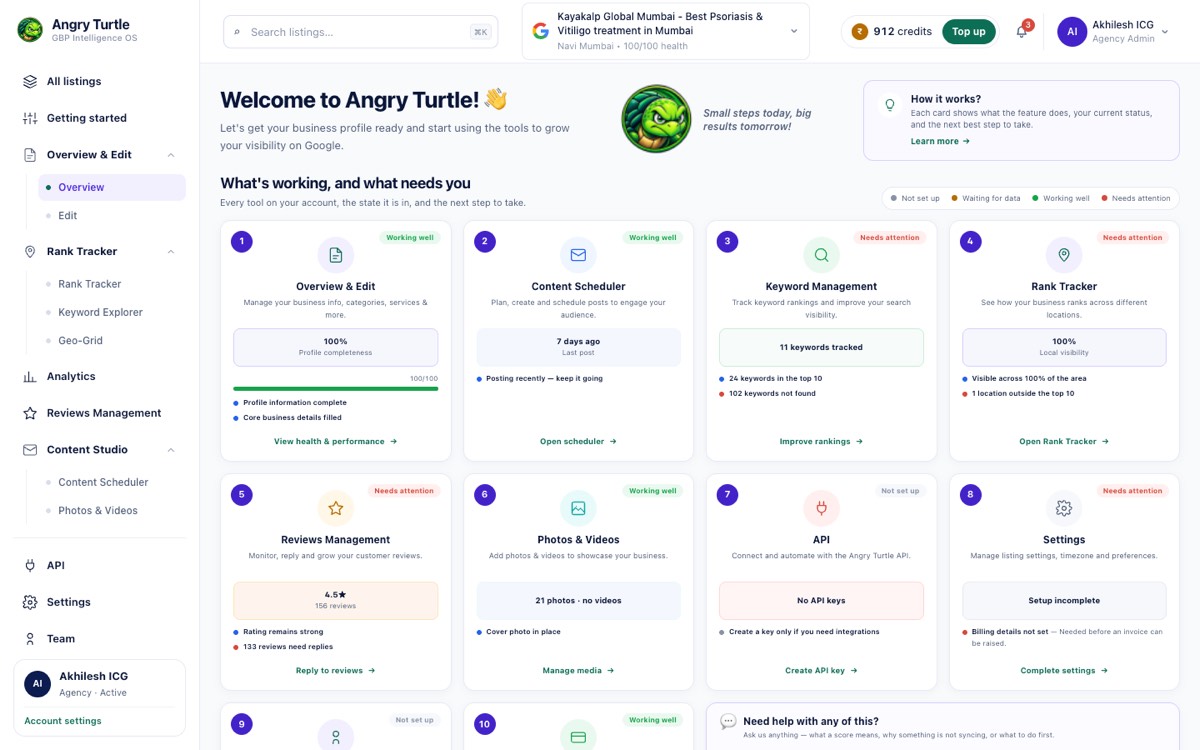

Ready to have this run for you?
Book a free audit — we'll show you where you stand in 48 hours.