 Angryturtle
Local SEO for Opticians and Eyewear Stores
·
An optical store can't fully close the sale online, no matter how good its GBP listing looks. A prescription needs an eye test, most Indian customers still want to try frames on before buying, and insurance or cashless coordination for procedures happens in person. What local SEO can do is get the right person into the store with the right expectations already set — the walk-in who needs an urgent eye test, the searcher comparing frame brands before visiting three stores, and the existing customer whose prescription just lapsed and needs a renewal reminder. Treating all three the same on GBP loses at least one of them. Search demand for seo opticians reflects exactly that split — getting the category, the brand names, and the photos right so each of the three searches above gets answered on its own terms instead of one blended one.
Split "eye test" intent from "eyewear shopping" intent in the category and description
"Optician" as a GBP category covers both prescription testing and frame retail, but the searches behind it split cleanly: "eye test near me" is urgent and often same-day, while "sunglasses shop" or "designer frames [city]" is browsing behaviour with a longer decision window. A store offering both should make the eye test service explicit and bookable, since that's the higher-urgency, higher-conversion search, while frame browsing gets its own service listing with brand names mentioned directly. Category and service-listing mechanics work the same way across categories →, but eyewear specifically benefits from separating the clinical service from the retail one inside a single listing.
List brands carried, not just "wide range of frames"
Customers searching for a specific brand — Ray-Ban, Fastrack, Titan, Lenskart's own lines if carried, or an international brand a store stocks — search by brand name more than by generic category once they've decided what they want. A GBP description and service listing that names actual brands captures those branded searches; "wide selection of frames" captures none of them. GBP products and services listing mechanics → apply directly here.
Photos need to answer "will they have my prescription range" before a customer walks in
A customer with a high-power prescription or a complex astigmatism correction often worries a store won't stock the right lens options, especially outside major optical chains. Photos and description text that mention lens types handled (high index, progressive, anti-glare coatings, contact lens fitting) reduce that uncertainty before the visit. Combine this with frame display photos that show actual stock rather than a stock photo of generic sunglasses. Photo cadence guidance generalises well here →.
Reviews should separate the eye test experience from the frame-buying experience
A one-line "good service" review doesn't tell a prospective customer whether the optometrist was thorough or whether the frame selection was good, and those are genuinely different concerns for different searchers. When asking for reviews, prompt for specificity on whichever part of the visit applies: the eye test itself for someone who came for a checkup, or frame selection and fitting for someone who came to buy. The core review generation framework → covers timing; the specificity prompt is the adaptation that matters for this category.
Prescription renewal reminders are a GBP post opportunity most opticians skip
Eye prescriptions typically need rechecking every one to two years, and most customers don't track when theirs is due. A GBP post reminding past customers — "time for your annual eye check?" — timed around the anniversary of common visit patterns, brings back a customer base that would otherwise drift to whichever store is nearest when they finally notice blurred vision. Post ideas by category and cadence → cover the mechanics; the reminder itself is specific to how eyewear purchasing actually cycles.
Multi-branch optical chains need branch-level stock accuracy
A customer who calls or checks GBP for a specific brand and finds it listed, then visits and discovers the branch doesn't stock that line, leaves frustrated and reviews accordingly. Chains need branch-specific service and product listings, not one shared brand-wide listing copied across every location. The multi-location local SEO guide → covers this generally, and managing GBP at scale across many locations → is directly relevant once an optical chain crosses even ten or fifteen stores.
Citation consistency matters because optical retail sits across health and retail directories both
Opticians appear on both general retail directories and health-adjacent ones since eye tests are a clinical service, which means citation management has to cover both ecosystems. Business listing coverage across the Indian directory set → and NAP consistency at scale → both apply, and a store that's consistent on JustDial but inconsistent on a health directory still has an open trust gap for the segment of customers checking that side of the ecosystem.
Track geo-grid rank separately for "eye test" and "eyewear" query clusters
A store might rank well for "opticians near me" broadly while underperforming on "eye test near me" specifically, or the reverse — strong on eye test bookings but invisible for branded frame searches. Splitting geo-grid tracking by these two query clusters shows exactly where the next round of review generation or GBP post effort should focus, rather than optimising blind against a single blended category term. Metro-level benchmarks → provide a useful baseline for what's achievable given local competition density.
AI answer engines are starting to field "best optician for [prescription type] near me" queries
As more searches shift into AI Overviews and conversational search, a query like "best optician for progressive lenses near me" gets summarised by an AI system pulling from GBP completeness, review specificity, and structured data, not just classic ranking signals. The AIO readiness pillar for GBP → and the schema markup pillar → both explain how a store's structured product and service data feeds into whether it gets surfaced in these newer answer formats at all.
Common mistakes specific to opticians and eyewear stores
The most common error is treating the eye test and the eyewear retail sides of the business as one undifferentiated listing, losing the urgency-driven "eye test near me" searcher to a competitor who made that service explicit. A second is generic frame descriptions with no brand names, which loses every branded search entirely. A third, common in multi-branch chains, is letting stock listings drift out of sync with what a branch actually carries, which converts a found customer into a frustrated one at the door.
When a strong prescription range went unmentioned
Clearview Opticians in Pune listed a single generic service line, "eye care and eyewear," and nothing else. A customer with a strong astigmatism correction, the kind not every store stocks lenses for, called three competitors before finding Clearview — and only because a friend mentioned it by name, not because the listing surfaced for anything specific. Once the store added distinct service entries for high-index lenses, progressive lenses, and contact lens fitting, alongside the actual brand names it carried in its product and service listing, the same customer profile started finding Clearview directly through search rather than word of mouth. Nothing about the store's actual stock changed. What changed was whether the listing said any of it out loud.
Who shouldn't spend on this yet
A single-location optician that's already at capacity for eye tests, booked out days in advance, gains little from local SEO spend aimed at driving more test bookings — the constraint there is optometrist hours, not visibility. And no listing work fixes a store whose actual lens turnaround time is unreliable or whose frame stock doesn't match what a customer was told over the phone; a better-ranked listing just delivers more disappointed first-time customers faster. A straightforward local SEO audit → should confirm which problem a store actually has before spending against the wrong one.
FAQ
Does an optical store need a separate GBP listing for eye tests versus retail? No — one listing per physical location, with eye testing and eyewear retail both represented as distinct services within that single listing.
Do opticians need to disclose lens pricing on GBP? Not required, but naming starting price ranges for common lens categories (single vision, progressive, high index) reduces the volume of price-shopping calls and sets accurate expectations before a visit.
How important is same-day eye test availability for local ranking? It isn't a direct ranking factor, but stating same-day availability in the description and posts captures the highest-urgency search segment, which converts at a much higher rate than browsing searches regardless of rank position.
What does SEO for opticians actually cover beyond a standard GBP setup? The category and service split above, brand-name listings, and dual citation coverage across health and retail directories are the parts that differ from a generic retail playbook — the rest of GBP mechanics (photos, reviews, posts) works the same as any local category.
Does listing specific lens brands and types actually change ranking, or just conversion? Mostly conversion — a searcher who finds Clearview-style detail in the listing is more likely to call knowing the store stocks what they need, though complete product and service listings also feed general profile-completeness signals.
Should an optician's GBP mention insurance or cashless coordination for procedures? Yes, if genuinely offered — naming it explicitly in the description or as an attribute saves a call that would otherwise ask the same question, and sets accurate expectations before a visit.
Angryturtle manages GBP and citation presence for multi-branch retail categories like opticians →, with geo-grid tracking split by exactly the query clusters this category needs and citation management across the health-and-retail directory overlap opticians sit inside.
Stop guessing where you rank locally.
Rank OS scores your Google Business Profile the way Google's local algorithm does — relevance, review health, freshness, entity authority and AIO readiness — and shows you exactly what to fix.
Book a live demo →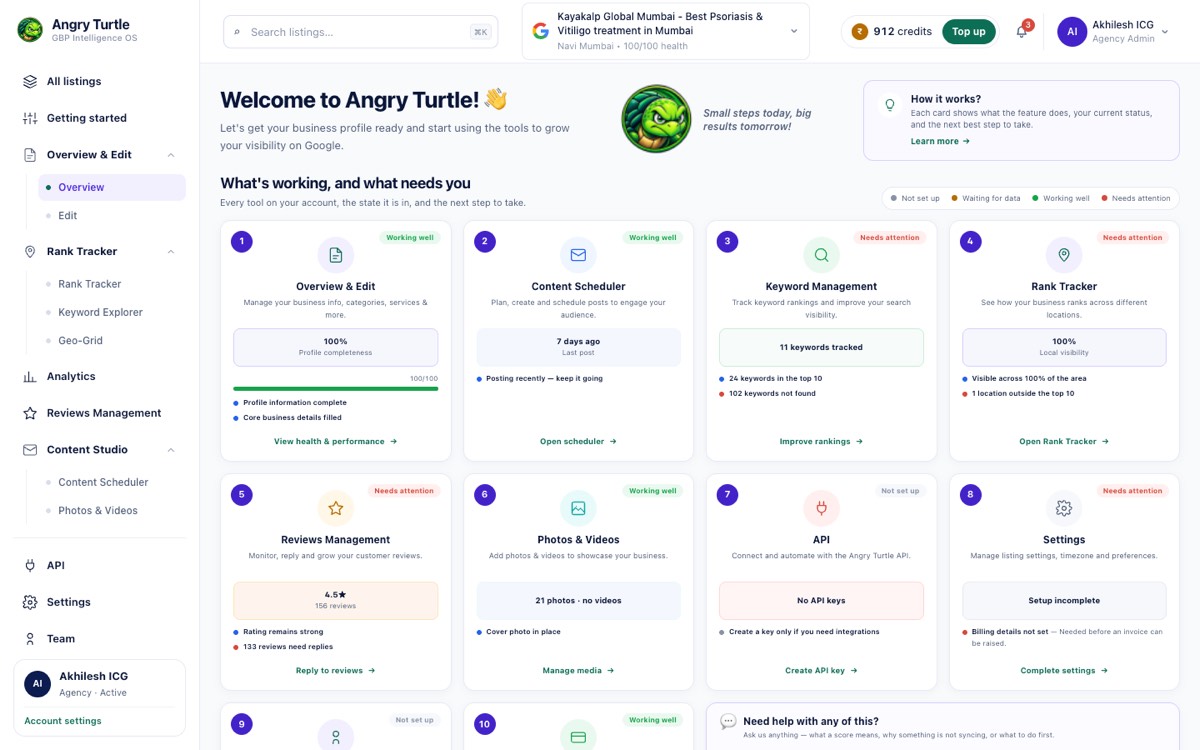

Ready to have this run for you?
Book a free audit — we'll show you where you stand in 48 hours.