 Angryturtle
Google Maps SEO: The Complete Guide for Indian Businesses
·
Google Maps SEO is the practice of getting a business to show up, and show up well, when someone searches for what you do on Google Maps or in the map-pack results that appear inside regular Google search. It's a different discipline from website SEO, even though the two names sound related — Maps SEO runs almost entirely through your Google Business Profile, not your site's on-page content or backlink profile, though the two do overlap at points this guide covers.
For Indian businesses specifically, Maps SEO carries a few wrinkles that generic guides written for the US market don't address: the directory ecosystem includes JustDial, Practo, Sulekha, and IndiaMART alongside Google, category names sometimes map differently onto Indian business types, and search behavior leans heavily on Hindi-English mixed queries that a profile needs to be readable against. A local search engine in Bangalore behaves a bit differently again — dense neighbourhood identity (Koramangala versus Indiranagar versus Whitefield are treated as near-distinct markets by searchers, even a few kilometres apart) means Maps SEO in that city rewards granular locality signals more than it does in cities with less neighbourhood-level brand recognition. This guide covers both the universal mechanics and the India-specific parts, using Bangalore examples throughout because the same principles read clearer against a real map than an abstract one.
Setting up the profile correctly from day one
Claiming and verifying a Google Business Profile is the entry point, and it's worth doing carefully rather than quickly, because mistakes made at setup — a wrong category, an incomplete address, a business name stuffed with keywords — create problems that are harder to undo later than to avoid up front. Claiming and verifying a GBP walks through the process end to end.
Category selection deserves more attention than most businesses give it. Google's category list runs to roughly 4,000 options, and picking the closest specific match rather than a broad, generic one is the single highest-leverage decision in the whole setup. GBP categories covers the mechanics; the short version is that "Dermatologist" beats "Doctor," and "Home Cleaning Service" beats "Service," every time. A café in HSR Layout choosing "Café" over the more specific "Coffee Shop" or "Breakfast Restaurant" it might actually qualify for is giving up relevance it didn't need to give up.
Business description, hours, service areas, products, and attributes all feed relevance too, and a profile that leaves these blank is competing with one hand behind its back against competitors who filled every field. Products, services, and attributes is the detailed reference for filling these out properly.
"Google map SEO" and "Google Maps SEO services" — same thing, different phrasing
Search for this topic and the phrasing splits three ways. Some people type "google map seo," singular, dropping the s the way you'd say "check the map" rather than "check the maps." Others type the grammatically correct "Google Maps SEO." A smaller group just searches "google seo india" as a catch-all for the same intent, local Google visibility, without specifying Maps at all. All three point at the same discipline this guide covers. Google doesn't distinguish between the singular and plural in how it treats the underlying work, and neither should a business owner trying to figure out what to fix.
What Google Maps SEO services actually cover, when a business hires someone rather than doing this in-house, is fairly consistent across agencies: an audit of the current profile against category and completeness gaps, a citation cleanup and build-out prioritised by directory authority, an ongoing review generation and response process, a posting cadence, and rank tracking that accounts for how much a Maps position shifts by exact searcher location. Angryturtle's managed Google Maps SEO service runs this as one coordinated process rather than a bundle of separate one-off tasks, which matters because the pieces reinforce each other — a citation fix without a category fix leaves half the gap unaddressed, and the reverse is also true.
Building the signals that actually move rank
Reviews are the loudest signal a Maps listing sends, both in volume and in how consistently they arrive. A profile with a steady trickle of reviews collected over two years reads differently to Google than one with the same number of reviews collected in a single promotional push last month. Review signal works as a gradient rather than a fixed gate — what matters is being competitive against whichever businesses currently occupy the map pack for your category and area, not clearing some universal number. Review generation and responding to reviews are the two halves of managing this well — getting reviews and answering the ones you get.
Citations, meaning your business listed accurately across other directories and platforms, reinforce the same trust signal from outside Google's own data. In India this list is longer than in most Western markets: JustDial and Sulekha for general listings, Practo specifically for healthcare, IndiaMART and TradeIndia for B2B and manufacturing, Zomato and Swiggy for food service. NAP and citations 101 is the foundational read, and citation aggregators in India covers which platforms feed which directories automatically versus which need to be claimed manually.
Posting activity and photo uploads feed the freshness dimension of ranking, which has grown more influential over recent algorithm cycles. A profile that posts occasionally and updates its photo library a few times a year signals ongoing operation in a way a static, set-and-forget listing doesn't. GBP posting and content cadence covers what a realistic schedule actually looks like — it doesn't need to be daily to be effective.
What actually goes wrong: a worked scenario in Koramangala
Take a hypothetical independent physiotherapy clinic in Koramangala, five years old, with a decent review history but flat Maps visibility despite genuinely good word-of-mouth in the neighbourhood. The owner assumes the problem is reviews, since that's the most visible number on the profile, and spends two months on a review push that lifts the count but doesn't move rank.
The actual constraint, once checked, turns out to be the category and service area setup. The clinic is listed under the generic "Physical Therapist" category with no service area configured at all, even though most of its patients come from a roughly 3-kilometre radius that includes parts of BTM Layout and Ejipura along with Koramangala itself. Because the service area was never set, Google is guessing at relevance for those adjacent searches rather than being told directly, and the clinic loses ground to competitors closer to the exact pin who've configured theirs properly. The category is also too broad relative to what a specific competitor two streets away has done — that competitor lists "Sports Physical Therapist," which pulls a chunk of the sports-injury search volume the generic listing never sees.
The fix here isn't more reviews. It's tightening the category to the most specific accurate match, configuring the service area to reflect the real patient catchment, and only then judging whether review volume is still the binding constraint. This is the failure mode worth naming explicitly: review count is the easiest thing to see on a profile, so it's the first thing owners try to fix, even when it isn't what's actually holding rank back.
The mirror failure runs the other way. A retail store in Indiranagar with excellent category and service area setup but only three total reviews, all more than a year old, is not going to out-rank a comparable competitor with fifteen recent reviews and active responses, no matter how well-configured everything else is. Setup fixes what setup can fix; it doesn't substitute for an actual signal of ongoing customer activity when that signal simply isn't there.
Getting the geography right
Service-area businesses — plumbers, electricians, home tutors, anyone who travels to the customer rather than the customer coming to a fixed address — need to configure this correctly in GBP or risk showing up for the wrong locations, or worse, none at all. Service area business explains the setup, and it matters more in Indian cities than the guides written for smaller Western towns tend to acknowledge, since a single service area can span multiple pin codes with genuinely different competitive density. A home-appliance repair business covering both Whitefield and the older parts of central Bangalore is effectively competing in two separate markets under one profile, and the service area configuration is what tells Google that's intentional rather than a mistake.
Multi-location businesses face a related but distinct problem: cannibalization, where two branches of the same chain end up competing against each other in the pack for overlapping searches instead of each capturing its own local territory. Multi-location SEO and location data management both address this at different scales, and managing multiple locations is the practical walkthrough.
A second worked scenario: a five-branch electronics retailer cannibalising its own listings
Take a hypothetical electronics retail chain with branches in Jayanagar, JP Nagar, Koramangala, Indiranagar, and Whitefield — five locations opened over six years, each set up independently by whichever store manager was in charge at the time. Overall footfall across the chain looks healthy, but two specific branches, Jayanagar and JP Nagar, roughly 4 kilometres apart, have been quietly underperforming for months relative to what their local ad spend should be producing.
The diagnosis here looks different from the Koramangala clinic case, because the individual profiles aren't badly configured — categories are correct, descriptions are filled in, reviews are steady. The problem only shows up in a geo-grid check run from points between the two branches rather than from either storefront directly: for a meaningful share of searches originating in the overlap zone, Google is alternating which of the two branches it surfaces, splitting what should be one location's clear territorial win into two profiles competing against each other for the same searcher. Neither branch's individual metrics look broken, which is exactly why nobody caught it by checking rank from inside each store.
The fix isn't consolidating the branches or picking a winner. It's tightening each branch's service area boundary so it stops claiming relevance for the overlap zone it's actually losing to its own sibling branch, and letting normal proximity do the rest of the work once the boundaries stop double-claiming the same searchers. Where the Koramangala case was a single listing under-configured against outside competitors, this one is two listings from the same owner accidentally competing against each other — a different failure mode that a single-location business, by definition, never runs into.
For businesses running exactly one location with no branches to coordinate, the calculus is simpler but not lower-stakes, since there's no second listing to fall back on if the first one is misconfigured. Getting profile setup, category, and service area right the first time matters more, not less, when there's only one shot at it.
Where "near me" fits into Maps SEO
A large share of the queries that trigger the map pack are literally "near me" searches or their implicit equivalent — a category name typed without a location because the searcher's device already knows where they are. Optimizing for this isn't a separate discipline from the rest of Maps SEO; it's mostly the same fundamentals read through a proximity lens. This shows up distinctly in Bangalore because of how strongly neighbourhood identity shapes search behaviour — someone in Whitefield searching "dentist near me" and someone in Jayanagar typing the identical query are functionally running two different searches, since proximity re-ranks the results completely between them. The Hinglish and vernacular query patterns that show up in Indian near-me searches — "ghar ke paas," mixed Kannada-English phrasing in Bangalore specifically — matter for how a business description and Q&A content is worded, since a profile that only anticipates English-only phrasing is invisible to a meaningful share of the actual query volume.
Tracking whether any of this is working
Rank position for a Maps listing isn't a single number the way it can feel like for a website keyword, because it shifts by exact location. A geo-grid check, which samples rank from a spread of points across the area a business actually serves, gives a far more honest picture than checking from a single phone in the owner's office — a business checking its own rank from a phone sitting in Koramangala will see a completely different result than a customer searching from HSR Layout three kilometres away, and neither single check tells the whole story. Geo-grid rank tracking covers how this is normally set up, and reading GBP performance data covers the metrics Google exposes natively — views, clicks, calls, direction requests — that sit alongside rank as a second signal of whether the work is landing.
What to check before assuming Maps SEO is the problem
Before spending effort on Maps SEO specifically, it's worth confirming the visibility gap is actually a Maps problem and not something upstream of it. Check whether the business is showing up at all in a basic category search from a phone physically in the service area — if it's entirely absent, that's usually a verification, suspension, or duplicate-listing issue, not a ranking one, and no amount of review generation or posting will fix it. Check the category against what the two or three competitors currently occupying the map pack have chosen, since a mismatch there often explains more of the gap than anything else on the profile. And check whether the business has ever actually looked at its GBP performance data — Views, Website Clicks, Phone Calls, Direction Requests — because a business assuming it has a ranking problem sometimes actually has a conversion problem: it's showing up fine and simply not converting views into calls, which is a different fix entirely.
The honest boundary: what Maps SEO doesn't do
Maps SEO doesn't fix a business with a genuine service or pricing problem — it makes a good business more visible, it doesn't make a mediocre one look better than the reviews underneath will eventually reveal. It also doesn't move fast for a brand-new profile with no track record; a listing that opened last month is working against a real disadvantage that setup and category precision help with but don't erase, since freshness and review history both take actual time to accumulate. And it has a hard ceiling in extremely low-search-volume categories or hyper-niche services, where there simply isn't enough query volume in a given neighbourhood for ranking work to move a meaningful number of customers, regardless of how well-optimised the profile is.
Frequently asked questions
Is Google Maps SEO the same thing as local SEO? They overlap heavily but aren't identical. Local SEO is the broader discipline, including your website's local content and backlinks. Maps SEO specifically concerns visibility inside Google Maps and the map pack, which runs mostly through your Google Business Profile rather than your website.
Is "google map seo" the same search as "Google Maps SEO"? Yes. The singular and plural phrasing describe the identical discipline — getting a business to rank in Google's map-based results — and this guide covers both under the same heading.
How long does Maps SEO take to show results in India? It varies by category competitiveness and city, but most businesses see the first measurable movement — usually in impressions or a few pack positions — within four to eight weeks of correcting category, completeness, and review response gaps, with prominence-driven gains compounding over months rather than weeks.
Do I need a website to rank on Google Maps? No. A website isn't required, and some map pack listings link only to a Facebook page. A website does reinforce the same NAP and structured data signals GBP relies on, which tends to help at the margins rather than being a hard requirement.
Does JustDial or Practo ranking affect my Google Maps rank? Not directly, but indirectly through citation consistency and, for review-heavy platforms like Practo in healthcare, through the broader online reputation signal that feeds into prominence. A strong presence on the relevant Indian directory for your category is worth maintaining on its own terms, not just as a Google-ranking tactic.
Is Google Maps SEO in Bangalore different from other Indian cities? The mechanics are the same everywhere GBP operates, but Bangalore's search behaviour leans harder on neighbourhood-level distinctions than most Indian cities — Koramangala, Indiranagar, Whitefield, HSR Layout, and Jayanagar each function as near-separate local markets to searchers, which makes service area configuration and category precision matter more there than in cities with a flatter neighbourhood identity. Local SEO in Bengaluru covers the city-specific landscape in more depth, including which directories and competitive patterns are most relevant there.
What's the single most common Maps SEO mistake in a competitive category? Assuming review count is the constraint when it's actually category or service area configuration, or the reverse — assuming setup is fine and pushing harder on reviews when the setup itself is the ceiling. The worked scenarios above cover both directions, plus the separate multi-branch case where the profiles are individually fine but compete against each other; the fix in every case starts with checking which failure mode actually applies before spending effort on the wrong one.
See also: what a map pack actually is, near-me searches, local search intent, and local SEO in Bengaluru for city-specific coverage.
Stop guessing where you rank locally.
Rank OS scores your Google Business Profile the way Google's local algorithm does — relevance, review health, freshness, entity authority and AIO readiness — and shows you exactly what to fix.
Book a live demo →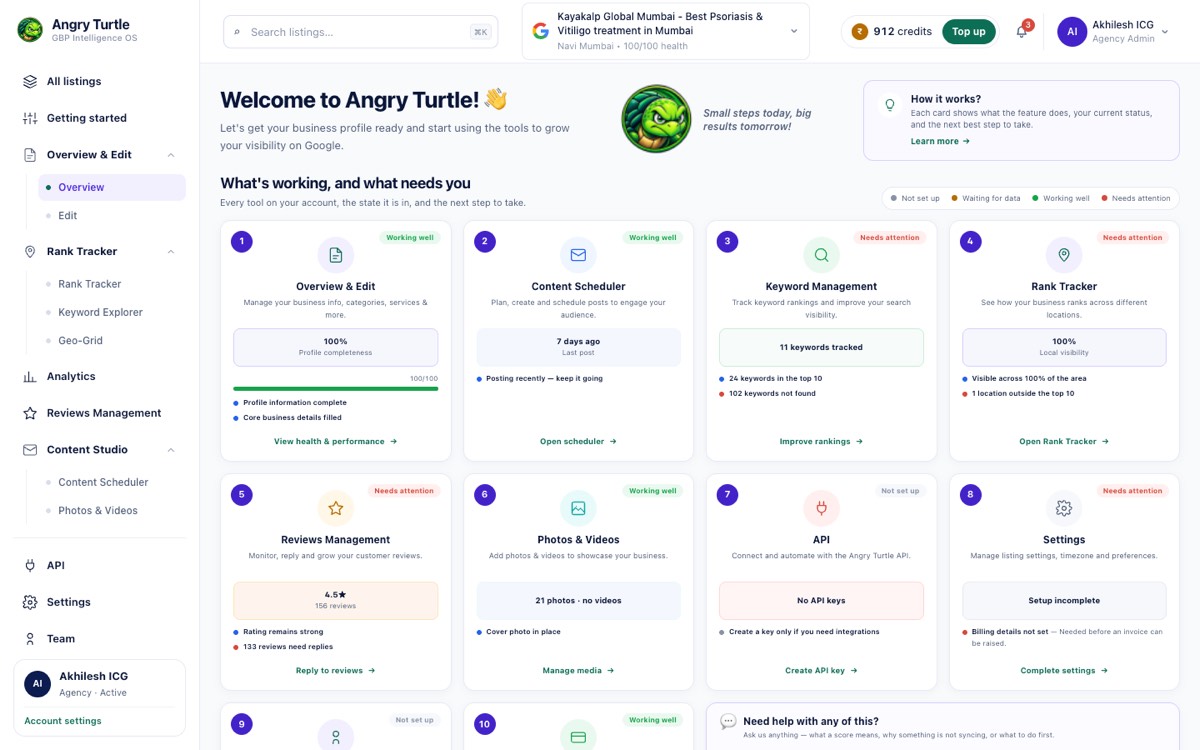

Related reading
Ready to have this run for you?
Book a free audit — we'll show you where you stand in 48 hours.