 Angryturtle
A family moving from Andheri to Whitefield doesn't shop the way a corporate relocation desk does, but both start the same way: three to five Google searches, three to five quote requests, and a decision made mostly on trust signals because nobody can physically inspect a moving company before the truck shows up. That single fact shapes almost everything about how packers and movers should run their Google Business Profile.
The quote-comparison problem
Movers compete in a category where price comparison happens before any human conversation. A customer opens four or five GBP listings in tabs, skims star ratings, glances at review counts, and shortlists two or three to call. A listing that's incomplete or stale gets filtered out at this stage regardless of actual service quality — it never survives to the phone call where price and trust would normally get discussed properly.
Category selection needs to be exact rather than broad, and choosing the right GBP category is worth reading before setup. "Mover" is the correct primary category for most packers and movers; "Moving and Storage Service" fits companies that also offer warehousing. Secondary categories should reflect the actual service mix: "Packaging Supply Store" if they sell boxes retail, "Storage Facility" if they run their own godown. Services should be listed as separate line items — local household shifting, intercity relocation, corporate office relocation, vehicle transportation, packing-only service — each with a description that states coverage area and what's included, because a customer comparing five tabs decides largely on what's visible without clicking through. GBP products and services setup covers the mechanics of listing each service correctly.
Trust signals matter more than price here
Movers operate in a category where fraud and no-shows are common enough that customers actively screen for them. A GBP profile that looks abandoned, has no recent photos, or hasn't responded to a single review reads as risk, not as a neutral gap. Reviews carry outsized weight in this specific category because a mover's biggest competitive threat isn't a marginally cheaper quote, it's a customer who's scared off entirely.
IBA-approved status, GST registration, and insurance coverage for goods in transit are the specific credentials that move a mover from "another quote" to "the one I'll trust with my furniture." These belong in the business description, in a pinned GBP post, and ideally photographed as a certificate image in the photo gallery. The core GBP optimisation checklist covers profile completeness generally; for movers specifically, certifications function almost like reviews — a proxy for "will this go wrong."
Photos of the actual fleet, uniformed staff, and packing materials in use do more work here than in most categories, because the customer is trying to answer one question before booking: will these people handle a fragile shipment carefully. Photo strategy that actually converts is worth reading in full, but for movers the priority order is: trucks and branding, packing materials and technique, loading in progress, and the team itself.
Review generation under time pressure
A completed move is a strange moment to ask for a review — the customer is exhausted, surrounded by boxes, and moving is rarely something people feel enthusiastic about even when it went well. The request has to land in a narrow window: right after unloading finishes and before the exhaustion turns into "I'll do it later" and later never comes.
WhatsApp works better than email for this because a mover's crew already has the customer's number from coordinating the move itself. A short message sent by the site supervisor, not a corporate number, within a few hours of completion, gets a meaningfully higher response than a generic automated follow-up two days later. The WhatsApp review request playbook covers message templates and timing in more depth, and general tactics for getting more Google reviews apply on top of the WhatsApp-specific timing.
Negative reviews in this category tend to cluster around a small number of real failure modes: damaged goods, delayed delivery, hidden charges added after the quote. Each deserves a specific, non-defensive response that states what happened and what changed, not a generic apology template. Responding to negative reviews well matters more for movers than most verticals because a prospective customer reading five one-star reviews with no company response will assume the complaints are true and unaddressed.
Ranking across intercity corridors
A mover running intercity routes — Delhi to Bengaluru, Mumbai to Pune, Chennai to Hyderabad — faces a structural problem: Google's local pack is inherently city-based, but the search itself ("packers and movers Delhi to Bangalore") spans two cities and doesn't map cleanly to either one's local pack.
The practical fix is dedicated landing pages per corridor, each naming both cities, the typical transit time, and the specific route logistics, rather than one generic "intercity relocation" page trying to rank for every corridor at once. Location pages built for this pattern explain the structure; the corridor-specific version simply needs both city names anchored early rather than one, and keyword cannibalization risk is worth checking if two corridor pages start competing for the same search.
For movers operating across multiple India metros, the multi-location local SEO guide covers the branch-management side, and city-specific service pages such as the ones under local SEO by city show the pattern of city-plus-service pairing that corridor pages should mirror, even though movers themselves sit outside that specific industry list.
Listing on IndiaMART and Sulekha alongside GBP
Movers get a meaningful share of leads through IndiaMART and Sulekha, both Indian directories where movers are a heavily searched category, independent of Google entirely. NAP consistency across these platforms and GBP matters because directory listing accuracy affects how confidently AI systems and Google itself associate a listing's reviews and information with the actual business, especially when a customer searches a company name after seeing it on one platform and checking reviews on another. NAP consistency at scale becomes a real operational problem once a mover has branches in more than two or three cities.
Angryturtle's citation engine checks NAP consistency across 20-plus platforms including the Indian directory layer relevant here, and flags duplicate listings that split review counts across two profiles instead of consolidating them into one, which quietly caps the trust signal a strong review base would otherwise send. Removing a duplicate Google listing is the manual version of that same fix.
When the corridor itself was invisible
Reliable Shift Packers and Movers had a strong local reputation in Chennai but ran its GBP listing under a single generic category, "Moving Company," with no mention of the Chennai-Hyderabad corridor it actually specialised in. A customer searching "packers and movers Chennai to Hyderabad" never saw the listing, because nothing on the profile signalled that route specifically, even though the company ran it weekly.
Building a dedicated corridor landing page naming both cities, and referencing it directly from the GBP description and a pinned post, gave that specific search something to match against for the first time. Local household shifting inquiries, which the company was already winning, didn't change. Corridor-specific inquiries, which it had been quietly losing to a Hyderabad-based competitor for years, started arriving.
Who shouldn't spend on this yet
A mover that's already running at full truck and crew capacity for the season, turning away work, doesn't need local SEO spend generating more leads it can't service — that just produces more no-shows and cancellations, which damages the exact review base this category depends on. And no listing work fixes a mover with a real pattern of damaged goods or hidden charges; a well-ranked profile just puts that pattern in front of more people faster. A local SEO audit should separate a genuine visibility gap from an operational one before any spend happens, and a mover with unresolved complaints should fix the underlying process first.
How Angryturtle helps
Angryturtle's GBP write-back capability publishes edits, posts, photos, and review replies directly to Google, which matters for a category where profile freshness during peak moving season (typically March to June, tied to the school year and lease cycles) has to happen faster than a manual dashboard-and-wait workflow allows. Rank OS scores review health and freshness as two of its five weighted dimensions, both of which map directly onto what actually moves a mover's ranking and conversion rate. Angryturtle works as both a self-serve platform a moving company can run itself and a managed service for operators who'd rather hand the calendar to someone else.
FAQ
Does GBP category choice actually affect which searches a mover shows up for? Yes. "Mover" versus "Moving and Storage Service" versus a generic "Transportation Service" changes which specific searches Google associates the profile with, and a mismatched category can quietly exclude a business from its most relevant searches.
How many reviews does a mover need before ranking well? There's no fixed threshold. Review count, recency, and response rate all function as a gradient signal rather than a gate — a newer mover with 20 recent, responded-to reviews often outperforms an older one with 100 stale ones.
Should intercity and local moving be on the same GBP profile? Usually yes for a single-location mover, with services listed separately, though a company with genuinely separate branch operations for local versus intercity should consider whether separate profiles per branch make more sense.
What's the single biggest reputation risk for a mover on Google? An unaddressed pattern of complaints about hidden charges or damaged goods, because these specific complaints read as credible and unresolved when there's no company response underneath them.
Do corridor-specific landing pages need their own GBP listing, or does the main profile handle it? The main GBP profile handles the local pack presence; the corridor landing page is a website asset that the GBP description and posts can point to, not a separate profile — running multiple GBP listings for one physical location risks a guideline violation.
Should a mover list every service it offers, even rarely-requested ones like piano transport? Yes, as a distinct service line rather than folding it into a generic "special items" note — a customer specifically searching for that capability needs to see it named, not assume it and call to ask.
Stop guessing where you rank locally.
Rank OS scores your Google Business Profile the way Google's local algorithm does — relevance, review health, freshness, entity authority and AIO readiness — and shows you exactly what to fix.
Book a live demo →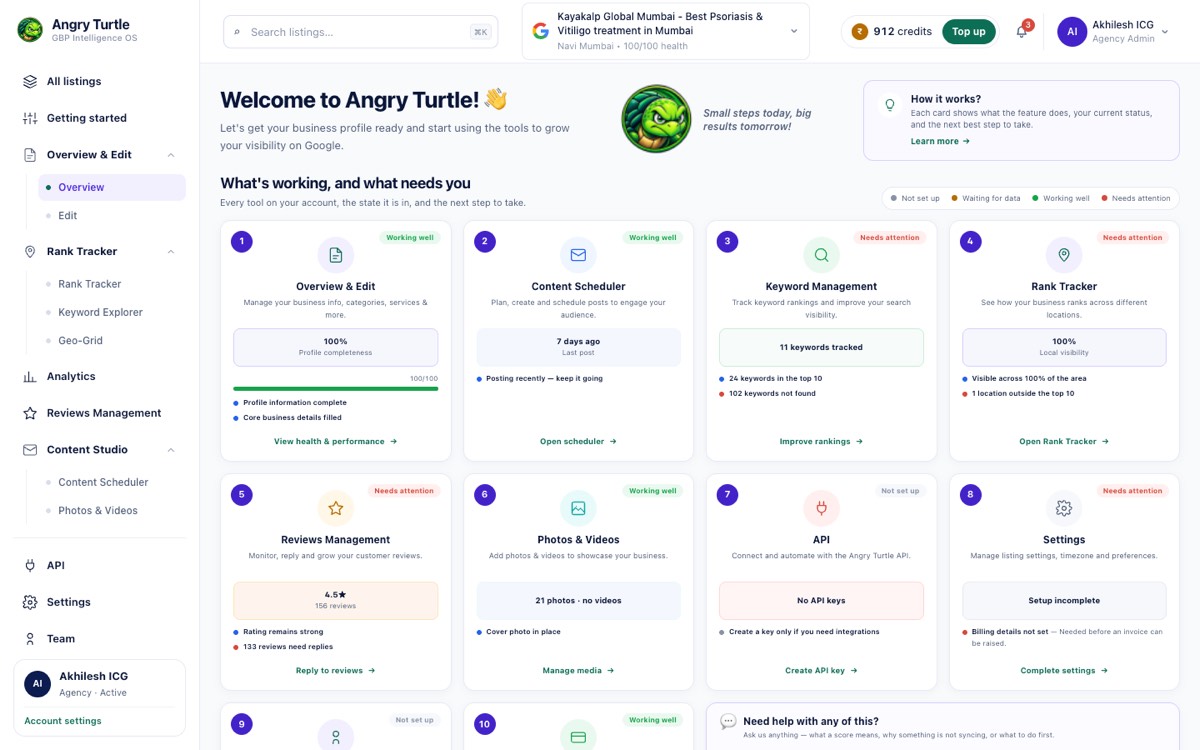

Ready to have this run for you?
Book a free audit — we'll show you where you stand in 48 hours.