 Angryturtle
Local SEO for Supermarkets and Kirana Chains
·
Grocery search is habitual, not deliberative. Nobody spends ten minutes comparing supermarkets before buying milk and vegetables — they search "supermarket near me" or "grocery store open now" once, pick whichever result looks legitimate and nearby, and then keep going back to that same store out of habit unless something breaks the pattern. That means local SEO for supermarkets and kirana chains isn't really about winning a considered decision. It's about winning the single habit-forming visit, and then not giving a customer a reason to break the habit.
Hours accuracy is the single highest-leverage thing a grocery listing can get right
A customer checking "grocery store near me open now" late in the evening or early morning is making a time-sensitive decision, and a GBP listing with wrong hours sends that customer to a competitor with a five-minute Google check instead of a wasted trip. Festival and holiday hours especially get neglected — a store that's open reduced hours on a specific festival but hasn't updated GBP loses every customer checking that day specifically. The GBP ranking factors guide → explains how completeness and accuracy signals like this weigh into visibility generally.
Category precision separates supermarket, hypermarket, and kirana positioning
"Supermarket," "Grocery Store," and "Convenience Store" are different GBP categories that set different customer expectations about range and pricing. A large-format store misclassified as a convenience store undersells its actual range in search, while a small kirana store over-claiming "supermarket" sets an expectation about selection it can't meet. Category selection mechanics → apply the same way here as elsewhere in retail.
List specific product categories carried, especially anything beyond generic grocery
A store that also carries fresh produce, a butchery counter, an in-house bakery, or imported and specialty items should list these as distinct service or product entries rather than relying on a generic "groceries" description. Customers searching "fresh vegetables near me" or "bakery near me" are searching for that specific category, and a supermarket carrying it invisibly under a generic grocery listing misses those searches entirely. Product and service listing mechanics on GBP → cover this directly.
Reviews for grocery retail skew toward freshness and billing speed, not ambience
Grocery shoppers rarely review on emotional experience the way a restaurant customer might; they review on freshness of produce, billing queue speed, and staff helpfulness finding items. Reviews that mention these specifics help a new customer decide faster than a generic star rating, and prompting for this kind of detail when requesting reviews produces a more useful review base than a blanket ask. The core review generation framework → covers timing mechanics; WhatsApp works particularly well here since many Indian kirana and supermarket chains already use it for delivery coordination. The WhatsApp review request flow → adapts directly.
GBP posts should track weekly offers and stock events, not generic promotions
Grocery retail has a natural weekly and monthly content rhythm — weekend offers, festival stock-up promotions, a new imported product line arriving. Post ideas by category and cadence → cover the general mechanics; grocery specifically benefits from a near-weekly posting cadence, since the content has a short shelf life and habitual customers check back often enough to notice fresh posts.
Multi-outlet chains need centralised management with branch-specific stock reality
Supermarket and kirana chains scaling past a handful of outlets face the same operational challenge as any multi-location retailer: a shared brand-wide description while each branch's actual footfall, stock range, and hours can differ meaningfully. Managing GBP at scale across many locations → and the multi-location local SEO guide → both cover this directly, and the discipline matters more here than in most retail categories because grocery customers form habits around a single outlet and rarely check whether a listing's stated hours or range still matches reality.
Citation consistency across delivery-platform listings, not just directories
Many Indian supermarkets and kirana stores now also list on quick-commerce and delivery platforms, and a mismatch between what's shown there and what's shown on GBP — different hours, different branch names — creates the same trust erosion a directory mismatch does. NAP consistency at scale → and business listing coverage across the Indian directory set → both apply, extended to this newer delivery-platform layer most retail categories don't need to think about as urgently.
Store locator pages matter for chains, since "nearest branch" is the actual query behind most grocery search
Almost every grocery search resolves to "which branch is nearest and is it open," which is exactly what dedicated store-locator infrastructure is built to answer quickly. Store locator SEO → covers this directly, and city landing pages for multi-branch presence → help a chain's city-level pages surface for broader "supermarket in [city]" research searches that precede the specific-branch lookup.
Track geo-grid rank at the neighbourhood level, since grocery competition is hyper-local
Grocery competition is won or lost within a very small radius, often a few hundred metres, which makes neighbourhood-level geo-grid tracking more useful here than city-wide category rank. A chain might dominate one neighbourhood cluster while barely appearing in a cluster three kilometres away with different competitive density. Metro-level benchmarks → provide useful context for how this varies across Indian cities generally.
Common mistakes specific to supermarkets and kirana chains
The most damaging mistake is outdated hours, especially around festivals, which converts a habitual customer's routine visit into a wasted trip and a real risk of that customer forming a new habit elsewhere. A second is generic "groceries" positioning that hides specialty categories like a bakery counter or imported goods section that would otherwise capture their own specific searches. A third, in multi-outlet chains, is letting branch-level information drift out of sync while managing everything from a single shared brand template.
When one branch's hours stayed wrong for three days
Freshline Supermarket's Nagpur branch listed the same generic hours as its two other city branches, copied from a shared template when the chain first set up all three profiles. During a local water-supply disruption that shut the Nagpur branch two hours early for three days running, the listing still showed standard hours, and customers who'd normally walk in from a five-minute radius made the trip and found the shutters down. The other two branches, unaffected, kept normal hours the whole time.
Once the Nagpur manager was given direct access to update just that branch's special hours field, rather than routing every change through a head-office marketing calendar that updated all three branches at once, the mismatch stopped recurring.
Who shouldn't spend on this yet
A single kirana store with a genuinely fixed, loyal neighbourhood customer base and no real competitor within walking distance gets very little from local SEO spend — the habit loop described above already works in its favour without help. Local SEO also can't fix a store with actual stock-availability problems or slow billing; a listing that ranks well just brings more customers to the same friction faster. An honest audit → before spending should confirm the gap is discovery, not operations.
FAQ
How often should a supermarket update its GBP hours? Immediately around any festival or holiday change, and reviewed at minimum monthly otherwise, since hours accuracy is disproportionately high-leverage for a habitual, time-sensitive search category like grocery.
Do kirana stores benefit from GBP as much as larger supermarket chains? Yes — a kirana store with an accurate, complete GBP listing competes directly with larger chains in "near me" search for its immediate neighbourhood, where proximity often outweighs brand recognition entirely.
Should grocery retailers respond to reviews about produce quality? Yes, and a specific, non-defensive response (acknowledging the specific complaint and stating what changed, such as a new supplier or quality-check step) does more to reassure future customers than a generic apology.
Should each branch of a kirana or supermarket chain manage its own GBP hours, or should head office control all of them centrally? Branch-level access for time-sensitive fields like special hours works better than a single head-office queue, especially for disruptions — managing multiple locations well means giving branch managers the specific permissions they need, not full control of everything.
Does a kirana store need a website at all if GBP handles most of the discovery? Not necessarily — for a single-location store with no delivery ambitions beyond the immediate neighbourhood, a complete, accurate GBP listing often does the job a website would otherwise be built for.
Angryturtle manages GBP and citation presence for multi-outlet retail chains including supermarkets and kirana groups →, with neighbourhood-level geo-grid tracking and branch-consistency workflows built for exactly this hyper-local competitive structure.
Stop guessing where you rank locally.
Rank OS scores your Google Business Profile the way Google's local algorithm does — relevance, review health, freshness, entity authority and AIO readiness — and shows you exactly what to fix.
Book a live demo →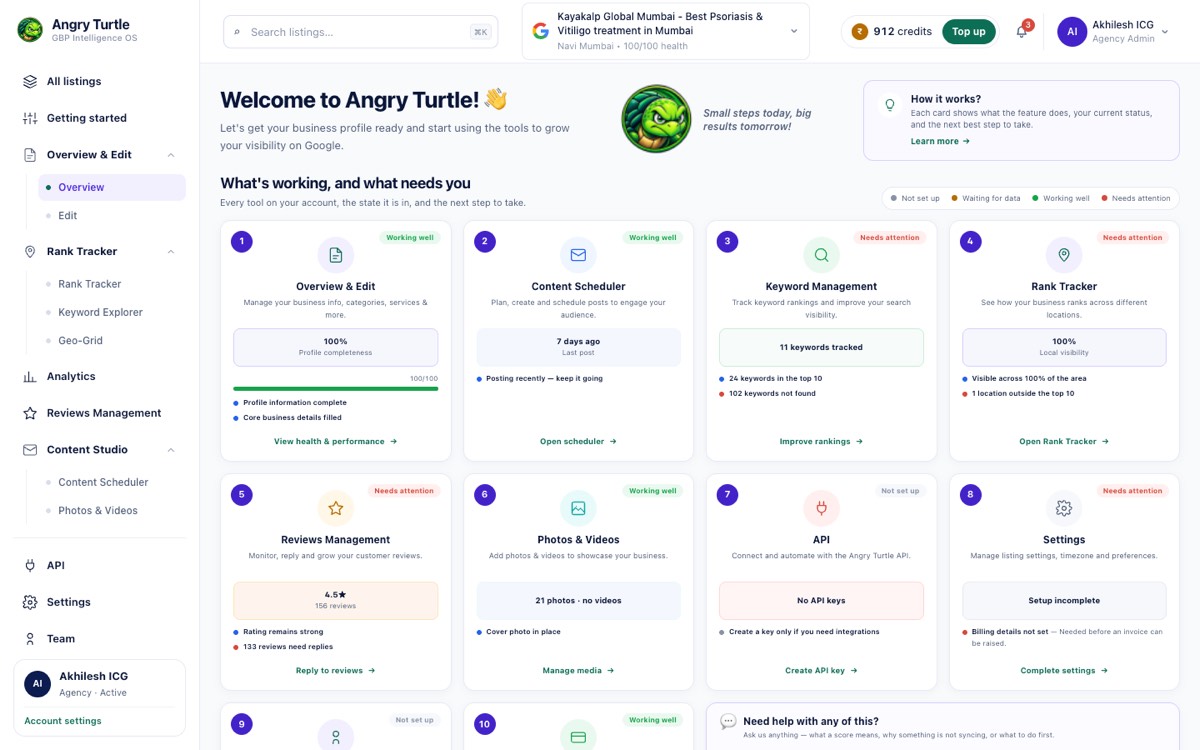

Ready to have this run for you?
Book a free audit — we'll show you where you stand in 48 hours.